South America · UY / URY
Flag of Uruguay
The Uruguay flag has nine horizontal stripes alternating white and blue, with a white square in the upper left corner holding a golden Sun of May. The sun has sixteen rays that alternate between straight and wavy.
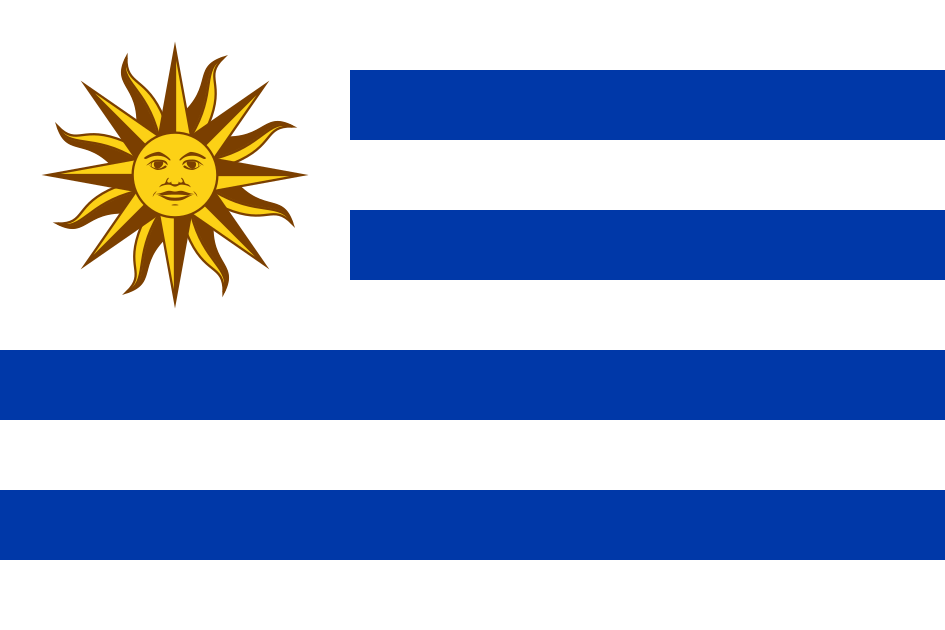
What the flag of Uruguay looks like
The flag of Uruguay has nine equal horizontal stripes: five white and four blue, starting and ending with white. In the upper hoist corner is a white square called the canton, which holds the Sun of May (Sol de Mayo). The sun is golden yellow and has a human face. It has 16 rays that alternate between straight and wavy ones. The ratio of the flag is 2:3.
The flag is called the Pabellón Nacional (National Pavilion). It is the most important of the three flags that have official status in Uruguay.
You can see its emoji form on the Uruguay flag emoji page, and there are image files on the download page.
Uruguay flag colors
Color codes measured from the official design. Use HEX for the web and CMYK for print.
HEX
#FFFFFFRGB
255, 255, 255CMYK
0, 0, 0, 0HEX
#0038A8RGB
0, 56, 168CMYK
100, 67, 0, 34Uruguay flag meaning and symbolism
The nine stripes stand for the nine original departments (provinces) of Uruguay. The country has since grown to 19 departments, but the number of stripes has stayed the same. The blue and white stripes were inspired by the flag of Argentina, and the color shades of the flag are not defined by law.
The Sun of May is a symbol of the May Revolution of 1810 in Buenos Aires, which began the independence movement across the former Spanish Viceroyalty of the Río de la Plata. The words Libertad o Muerte (Liberty or Death) are linked to the independence story, but they appear on the flag of the Treinta y Tres, not on the national flag.
History of the Uruguay flag
In the early 19th century, the territory of Uruguay was known as the Banda Oriental. It was claimed by Spain, then by Portugal and Brazil, and by Buenos Aires. José Gervasio Artigas, the national hero, led a movement for the region's autonomy and introduced a flag in 1814 with blue and white horizontal bands, and from 1815 the main flag of his League had a diagonal red stripe across them. This Flag of Artigas is still one of the official flags of the country.
In 1825 a group known as the Treinta y Tres Orientales (the Thirty-Three Orientals) landed at Agraciada Beach on 19 April 1825 to free the territory from Brazilian rule. They carried a tricolor flag with the words Libertad o Muerte painted in the center. Independence from Brazil was declared soon afterward, and Uruguay was established as an independent state in 1828.
The first national flag, adopted by law in December 1828, had 19 alternating stripes, which proved too many to read from a distance. The law of 11 July 1830 reduced the number to nine, giving the flag its present form. The design is credited to Joaquín Suárez.
Why Uruguay has three flags
Uruguay has three official national flags. The first is the National Pavilion with nine stripes. The second is the Flag of Artigas, with the diagonal red stripe, which honors the country's founding hero. The third is the Flag of the Treinta y Tres, the banner of the 1825 liberation movement. The Flag of Artigas and the flag of the Treinta y Tres were declared official on 18 February 1952. On 19 June each year schoolchildren take the pledge of allegiance to the flag.
Flags that look like the Uruguay flag
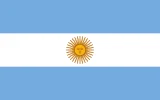
The flag looks like the flag of Argentina because both use blue and white stripes and the Sun of May. The Argentine flag has three horizontal stripes in a lighter sky blue, with the sun in the center, while Uruguay's has nine stripes and the sun is in the corner. The reason is shared history: both countries were part of the Spanish Viceroyalty and later fought for independence under the influence of the May Revolution. The flag of Greece also has nine blue and white stripes, but it has a cross in the canton instead of a sun.
Uruguay flag facts
| Country | Uruguay |
|---|---|
| Flag adopted | July 11, 1830 |
| Proportions | 2:3 |
| Colors | #FFFFFF, #0038A8 |
| Symbols | Sun, Sun of May |
| Flag emoji | 🇺🇾 |
| Country code | UY, URY (ISO 3166) |
| Capital | Montevideo |
| Continent | South America |
| Population | 3,444,263 |
| Area | 176,215 km² |
| Currency | Uruguayan peso |
| National anthem | National Anthem of Uruguay |
Uruguay flag: frequently asked questions
Why do the flags of Uruguay and Argentina look the same?
Both use blue and white colors and the Sun of May, which come from the independence movement that began in Buenos Aires in 1810. Uruguay was part of the same region, the Río de la Plata, and its flag was modeled on Argentina's.
What do the stripes on the Uruguay flag mean?
The nine stripes represent the nine original departments of the country. Uruguay now has 19 departments, but the flag was not changed.
Why is the sun on the Uruguay flag?
The Sun of May represents the May Revolution of 1810 and the birth of independence in the region. It also appears on the flag of Argentina.
Why does Uruguay have three flags?
Uruguay has three official flags: the National Pavilion, the Flag of Artigas and the Flag of the Treinta y Tres. The Artigas and Treinta y Tres flags come from the independence wars of the early 19th century.
When did Uruguay change its flag?
The first flag, adopted in 1828, had 19 stripes. It was changed to the nine-stripe design by a law of 11 July 1830, and the stripe design has stayed the same since.
What is the Uruguay flag called?
Its official name is the National Pavilion (Pabellón Nacional). It is the main one of Uruguay's three official flags, and has nine alternating white and blue stripes with the Sun of May on a white canton.
How many rays does the sun on the Uruguay flag have?
The Sun of May has 16 rays, alternating between triangular and wavy. A decree of 18 February 1952 officially specified a radiant circle with a face surrounded by 16 rays. Before that the sun was usually drawn with a face, but the design was not formalized.
Which country did Uruguay belong to before independence?
The territory, then called the Eastern Province, was invaded by the Kingdom of Brazil in 1816 and annexed as the Cisplatine Province in 1821. After a war, the Preliminary Peace Convention of 28 August 1828 established Uruguay as an independent state.