Europe · GR / GRC
Flag of Greece
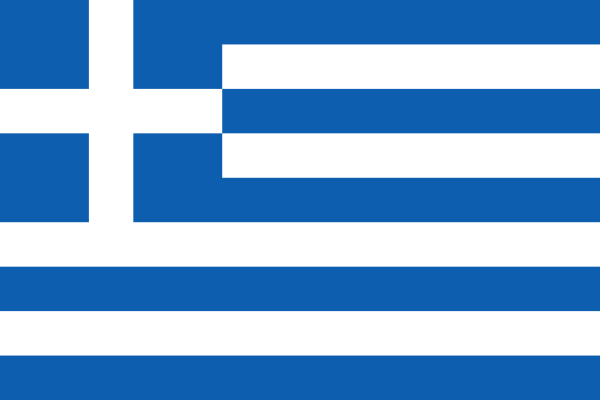
The Greece flag has nine horizontal stripes alternating blue and white, with a white cross on a blue square in the upper left corner. It dates back to the Greek War of Independence and was adopted in 1822.
What the flag of Greece looks like
The Greek flag is made of nine equal horizontal stripes, five blue and four white, starting and ending with blue. In the upper left corner, at the hoist, is a blue square canton containing a white Greek cross, with arms of equal length that reach the edges of the square. The flag is 2:3 in proportion.
The shade of blue has changed over the years. It has been shown as a light sky blue and as a deeper royal blue, depending on the period and who was in power. The government has never specified exactly which shade of blue should be used, and the flag has tended to be a relatively dark blue since the late 1960s.
Greece has used more than one version of the design. Alongside the striped flag there is a plain flag with a white cross across a blue field, reaching the edges of the cloth. It was the land flag for much of the country's history, and it is the other flag people mean when they ask why Greece has two flags. The same cross-on-blue pattern is still used as the Navy's jack and, in a square version with a saint in the center, as the war flag of the Army and Air Force. You can also see the striped design in miniature as the Greece flag emoji.
Greece flag colors
Color codes measured from the official design. Use HEX for the web and CMYK for print.
HEX
#0D5EAFRGB
13, 94, 175CMYK
93, 46, 0, 31HEX
#FFFFFFRGB
255, 255, 255CMYK
0, 0, 0, 0Greek flag meaning and symbolism
The most widely repeated explanation is about the stripes. The Greek motto during the war of independence was Eleftheria i Thanatos ("Freedom or Death"), which has nine syllables in Greek, one for each stripe. The nine stripes have no official meaning, and this reading is traditional.
Another reading says the nine stripes stand for the nine geographical regions of Greece.
The white cross symbolizes Christianity. White and blue might symbolize the colors of the Greek sky and sea.
History of the Greek flag
There was no national flag in ancient Greece. City states used their own emblems, so an "ancient Greek flag" in the modern sense does not exist.
The modern flag comes out of the Greek War of Independence against the Ottoman Empire, which began in 1821. Rebels flew many banners, often showing a cross, the Virgin Mary or saints, with slogans like "Freedom or Death". A secret society called the Filiki Eteria prepared the uprising, and its leader Alexander Ypsilantis carried a flag with a phoenix rising from flames when he crossed into Moldavia in March 1821. Another well-known banner is a white cross on a blue field, and a blue-and-white color scheme became popular, especially at sea.
The First National Assembly at Epidaurus adopted the national flag on 13 January 1822, abolishing the revolutionary flags. A decree of 15 March 1822 set a plain white cross on blue for the land flag and the nine stripes with the cross in the canton for the naval ensign. When the Kingdom of Greece was established in 1832, King Otto added the royal coat of arms in the center of the cross for military flags, and from 1863 crowns were used in its place.
In the 20th century the flags changed with each political regime. The crowns were removed in 1924 with the Second Hellenic Republic, and the proportions were set at 2:3 in 1930. Under the military junta of 1967-74 the sea flag was made the sole national flag in 1969 and the proportions were changed to 7:12 in 1970. After the restoration of democracy, a law of 1975 made the plain cross flag the sole flag, and in 1978 the striped sea flag became the single national flag again, with a ratio of 2:3.
Greece flag facts
| Country | Hellenic Republic |
|---|---|
| Flag adopted | December 22, 1978 |
| Proportions | 2:3 |
| Colors | #0D5EAF, #FFFFFF |
| Symbols | Greek cross |
| Flag emoji | 🇬🇷 |
| Country code | GR, GRC (ISO 3166) |
| Capital | Athens |
| Continent | Europe |
| Population | 10,482,487 |
| Area | 131,957 km² |
| National anthem | Hymn to Liberty |
Greece flag: frequently asked questions
Why does Greece have two flags?
Greece developed a land flag, a white cross on a blue field, and a sea flag with nine blue and white stripes and a cross canton. Since 1978 the striped design is the single official national flag, and the plain cross pattern survives mainly in military uses such as the Navy jack and the Army war flag.
What was the original Greek flag?
The national flag was adopted on 13 January 1822 at the National Assembly at Epidaurus, during the War of Independence, and a decree of March 1822 set the land and sea patterns. They combined blue and white with a white cross. Earlier rebel banners varied.
Why did Greece change its flag?
Its flag changed with its governments rather than its basic design. The royal coat of arms and later crowns were added under the monarchy and removed with the republic in 1924, the proportions and the choice of sole national flag changed under the junta and again in 1975, and in 1978 the striped version became the only national flag.
What does the number of stripes on the Greek flag mean?
The nine stripes are said to match the nine syllables of the motto "Eleftheria i Thanatos" (Freedom or Death). The stripes have no official meaning, and this is the most popular interpretation.
What country is the flag emoji 🇬🇷?
The emoji shows the flag of Greece, a country in southeastern Europe whose capital is Athens. It appears as blue and white stripes with a cross in the corner.
What is the oldest Greek flag?
Ancient Greece had no national flag, since city states used their own emblems. The design of the modern flag first appeared in 1807 at the Evangelistria monastery in Skiathos, and it was adopted as the national flag on 13 January 1822. Some historians suggest it derives from the older Kallergis family arms.
What is the most famous flag of Greece?
The most famous Greek flag is the blue and white striped national flag, with nine stripes and a white cross in the corner, popularly called the Galanolefki. It has been the single national flag since 1978. The cross symbolizes Christianity.
What are some interesting facts about the Greek flag?
The nine stripes are said to match the nine syllables of "Freedom or Death", the cross is a symbol of Christianity, and the shade of blue has varied from light to dark over time. The flag was adopted in 1822 and was first internationally saluted by British, French and Russian forces in Nafplio in 1828.