South America · BR / BRA
Flag of Brazil
The Brazil flag is a green rectangle with a large yellow diamond, and in the diamond a blue globe with 27 white stars and a white banner reading Ordem e Progresso. The stars show the night sky over Rio de Janeiro, one star for each state and the Federal District.
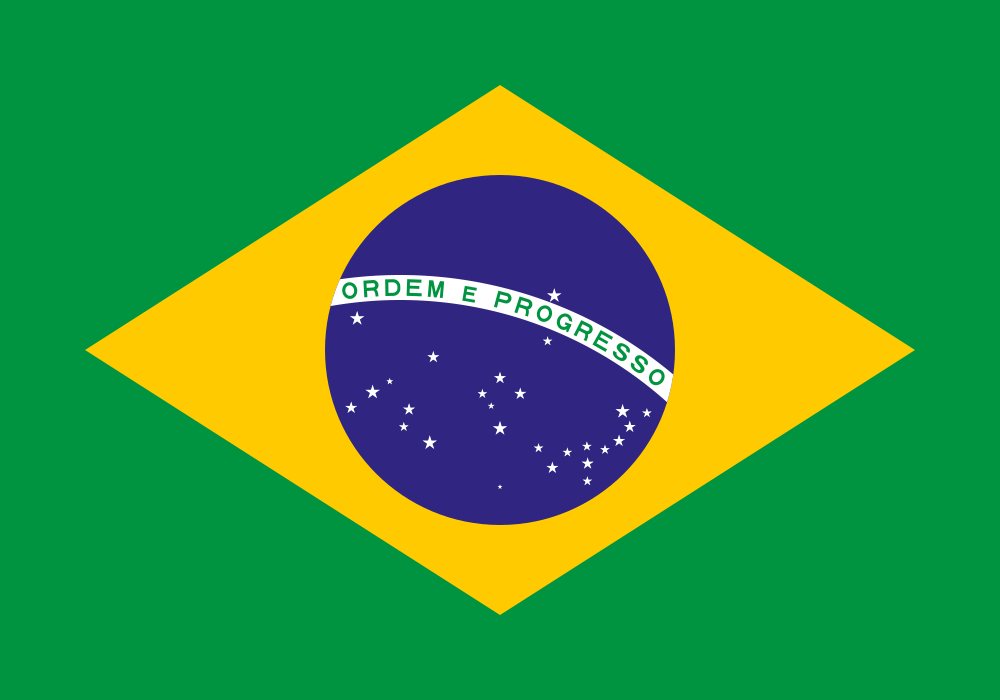
What the flag of Brazil looks like
The flag of Brazil, called Auriverde ("gold-green") in Portuguese, is a green field with a yellow rhombus, or diamond, whose points almost touch the edges. In the center of the diamond is a blue disc, covered with 27 white five-pointed stars of different sizes. A curved white band crosses the disc from left to right and carries the green words Ordem e Progresso ("Order and Progress"). The proportions are 7:10.
The disc shows the sky as it appeared over Rio de Janeiro at about 8:30 in the morning on 15 November 1889, the day the republic was proclaimed, drawn as if seen from outside the celestial sphere. The Southern Cross is easy to find among the stars. The single star above the band is Spica, which represents the state of Pará. The Brazil flag emoji and a high-resolution file on the Brazil flag download page keep this layout.
Brazil flag colors
Color codes measured from the official design. Use HEX for the web and CMYK for print.
HEX
#009440RGB
0, 148, 64CMYK
100, 0, 57, 42HEX
#FFCB00RGB
255, 203, 0CMYK
0, 20, 100, 0HEX
#302681RGB
48, 38, 129CMYK
63, 71, 0, 49Brazil flag meaning and symbolism
The colors of the Brazil flag are often explained as green for the forests and farmland, yellow for gold and mineral wealth, and blue and white for the sky, rivers and peace. That is a popular explanation. It is not the original meaning: the green and yellow came from the imperial flag, where green stood for the House of Braganza of Emperor Pedro I, and yellow for the House of Habsburg of his wife, Empress Maria Leopoldina. When the republic was created, the colors were kept, but the meaning was changed.
The 27 stars represent the 26 states and the Federal District. Each star is a named star or constellation, such as Sirius, Canopus or the Southern Cross, and each is assigned to a state. The motto Ordem e Progresso comes from the positivist philosophy of Auguste Comte, which was influential among the officers who founded the republic: "love as a principle, order as a basis, progress as a goal". For a different kind of flag with a message, see the flags of the world.
History of the Brazilian flag
After independence from Portugal in 1822, Brazil became an empire. Its flag was based on a design by the French artist Jean-Baptiste Debret, first made as the standard of Prince Pedro: a green field with a yellow rhombus and the imperial coat of arms in the center. This flag was used for 67 years, until the end of the monarchy.
The republic was proclaimed on 15 November 1889. On the first days, a provisional flag was raised that looked like the flag of the United States, with green and yellow stripes and a blue canton with stars. It was flown only from 15 to 19 November, when Marshal Deodoro da Fonseca rejected it because it looked too similar to another country's flag. On 19 November 1889, the new flag was adopted. The design was the work of Raimundo Teixeira Mendes, with Miguel Lemos, Manuel Pereira Reis and Décio Villares. The arms of the empire were replaced by the blue disc.
The number of stars changed as the number of states changed. The flag had 21 stars at first, and the number was raised several times as new states were created. The last change was in 1992, when four stars were added for new states, bringing the total to 27, and the arrangement is set by a law from 1971. Brazil celebrates Flag Day on 19 November.
Brazil flag facts
| Country | Brazil |
|---|---|
| Flag adopted | May 11, 1992 |
| Proportions | 7:10 |
| Colors | #009440, #FFCB00, #302681 |
| Symbols | Canis Major, Triangulum Australe, Octans, Canis Minor, five-pointed star, Scorpius |
| Flag emoji | 🇧🇷 |
| Country code | BR, BRA (ISO 3166) |
| Capital | Brasília |
| Continent | South America |
| Population | 214,211,951 |
| Area | 8,515,767 km² |
| Currency | Brazilian real |
| National anthem | Brazilian National Anthem |
Brazil flag: frequently asked questions
What does the Brazil flag symbolize?
The green and yellow come from the imperial flag, where green stood for the House of Braganza and yellow for the House of Habsburg; popular tradition also reads them as forests and gold. The blue disc with white stars shows the sky over Rio de Janeiro on the day the republic was proclaimed, 15 November 1889. Each star stands for one state or the Federal District.
Why does Brazil's flag have 27 stars?
There is one star for each of the 26 states and one for the Federal District. The number has changed over time as new states were created; the most recent change, in 1992, added four stars.
What do the words on the Brazilian flag mean?
Ordem e Progresso means Order and Progress in Portuguese. It comes from the motto of Auguste Comte's positivist philosophy: love as a principle, order as the basis and progress as the goal.
Why did Brazil copy the US flag?
Brazil did not copy it for long. A temporary flag with stripes and stars, similar to the American one, was raised after the republic was declared in 1889, but it was replaced after four days by the current design.
What was Brazil's old flag?
The imperial flag, used from 1822 to 1889, was a green field with a yellow diamond and the coat of arms of the empire in the middle. The republic kept the colors and shapes but changed the center.
What four colors make up the flag of Brazil?
The four colors are green, yellow, blue and white. White appears in the stars and the band across the globe, and the lettering on the band is green.
What is special about Brazil's flag?
The blue globe shows a real sky: the stars as seen over Rio de Janeiro on 15 November 1889, each sized by the apparent magnitude of the real star and assigned to a state or the Federal District. The precise placement of 27 stars makes it one of the most complicated national flags to construct.
Why did Brazil change their flag?
Brazil replaced its imperial flag after the republic was proclaimed on 15 November 1889. The new flag, adopted on 19 November 1889, kept the green and yellow but replaced the imperial arms with a blue globe and the motto. Stars have since been added as new states were created, most recently on 11 May 1992.
What flag is 🇧🇷?
🇧🇷 is the flag emoji of Brazil: a green field with a yellow diamond and a blue globe with white stars and the motto Ordem e Progresso. You can see the emoji on the Brazil flag emoji page and get a picture of the flag on the download page.
What is a fun fact about the Brazilian flag?
The sky on the flag is drawn as if seen from outside the celestial sphere, so the Southern Cross appears in mirror image compared with the real sky. At the chosen time, about 8:30 a.m. on 15 November 1889, Rio de Janeiro was in bright daylight, so no stars were actually visible.