Europe · AT / AUT
Flag of Austria
The Austria flag is a horizontal triband of red, white and red in equal bands. The design originated from the arms of the Babenberg dynasty and was first recorded in 1230, which makes it one of the oldest national flag designs still in use.
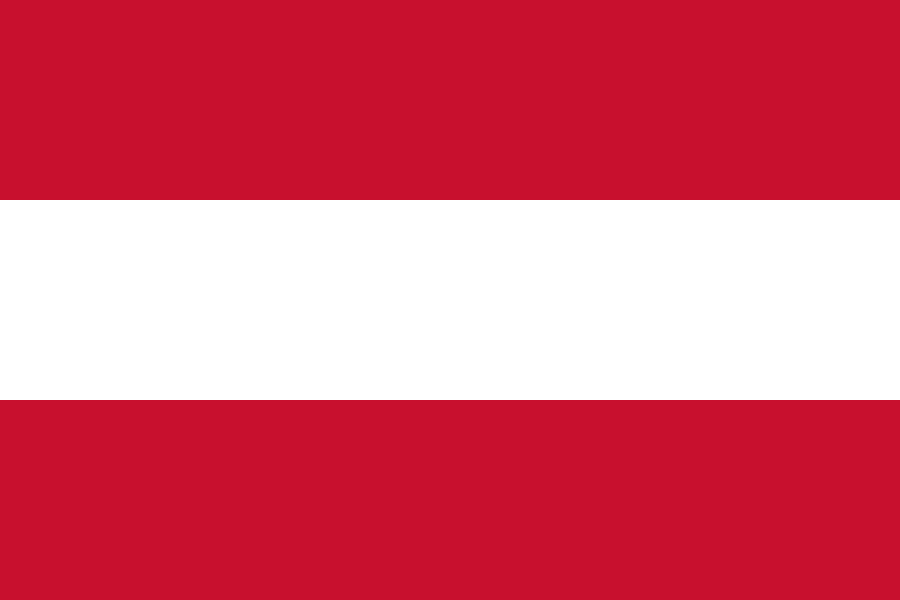
What the flag of Austria looks like
The flag of Austria has three horizontal bands of equal height: red at the top, white in the middle and red at the bottom. The proportions are 2:3. Austrian law does not specify the shades, but a regulation of 2018 sets the red as Pantone 186 C.
There are two versions in practice. The civil flag is the plain triband and is the one people fly from homes, shops and at sporting events. The state flag, used by government offices and the armed forces, has the national coat of arms in the center of the white band: a black single-headed eagle wearing a gold mural crown, with a hammer and a sickle in its talons and a broken chain around each of its legs. That is why Austria is sometimes said to have two flags: the extra detail is the coat of arms, not a different design.
If you want a small version for messages or websites, see the Austria flag emoji.
Austria flag colors
Color codes measured from the official design. Use HEX for the web and CMYK for print.
HEX
#C8102ERGB
200, 16, 46CMYK
0, 92, 77, 22HEX
#FFFFFFRGB
255, 255, 255CMYK
0, 0, 0, 0Austria flag meaning and symbolism
Unlike many national flags, the Austrian flag does not have an official meaning for its colors. Red and white are the colors of the old arms of the Babenberg family, who ruled Austria from the 10th century to 1246, and they are the colors of the historic Bindenschild, a shield with a white band across a red field. The flag is a version of that shield stretched out into three stripes.
The best-known explanation is a legend. During the siege of Acre in 1191, during the Third Crusade, Duke Leopold V of Austria is said to have fought so fiercely that his white tunic was soaked in blood. When he took off his belt, a band of white remained where it had been. The duke then took the red-white-red pattern as his banner. The incident is documented as early as 1260, but the red-white-red arms were in use by the Babenbergs before and after Leopold V, and the origin of the Bindenschild has not been conclusively established.
On the state flag, the eagle is a symbol of the republic. The mural crown stands for the bourgeoisie, the hammer for the workers and the sickle for the farmers. The broken chains were added after 1945 to show the end of the Nazi period.
History of the Austrian flag
The red-white-red triband is first documented in a seal on a deed of 30 November 1230, issued by the Babenberg duke Frederick II. After the dynasty died out in 1246, the colors were adopted by Ottokar II of Bohemia and, after the Battle on the Marchfeld in 1278, by the Habsburgs, and they gradually became the coat of arms of the Habsburgs' Hereditary Lands. The Habsburgs' own family colors were black and yellow, and the black-yellow flag was used as the national flag, in a modern sense, of the Austrian part of the monarchy until 1918.
After the First World War and the dissolution of Austria-Hungary in 1918, the newly formed rump state of German Austria adopted the red-white-red triband as its national flag. In 1938 Austria was annexed by Germany and the flag was replaced.
The red-white-red flag was restored when Austria's independence was re-established in 1945. The coat of arms with broken chains dates from this period, and the Federal Constitution still names red-white-red as the colors of the republic.
Austria-Hungary flag and other old Austrian flags
The state known as Austria-Hungary (1867-1918) never had one official national flag. It was a union of two states, the Austrian Empire and the Kingdom of Hungary, each with its own flags. Austria used black and yellow, and Hungary used red, white and green. For the shared institutions, such as the navy and the merchant fleet, a combined flag was used: Austrian red-white-red next to Hungarian red-white-green, each with its own coat of arms. This is why searches for the Austria-Hungary flag turn up several different images. During the First World War the imperial and royal armed forces flew the black-yellow banner and the war ensign.
Before 1867, the Austrian Empire (1804-67) used a black-and-yellow flag, the family colors of the Habsburgs, which were in part derived from the banner of the Holy Roman Empire. Beginning in the reign of Emperor Joseph II, the navy used an ensign based on red-white-red.
Flags that look like the Austrian flag
The closest flag is that of Latvia, which is dark carmine red with a narrow white band in the middle. Latvia's white stripe is only one-fifth of the height and the ratio is 1:2, so it looks longer and thinner than Austria's. The flag of Peru is also red-white-red but it is vertical, and its state version shows the coat of arms in the middle. Canada's flag has red bands on either side of a white square with a leaf in the middle.
Austria flag facts
| Country | Austria |
|---|---|
| Flag adopted | May 1, 1945 |
| Proportions | 2:3 |
| Colors | #C8102E, #FFFFFF |
| Flag emoji | 🇦🇹 |
| Country code | AT, AUT (ISO 3166) |
| Capital | Vienna |
| Continent | Europe |
| Population | 8,979,894 |
| Area | 83,879 km² |
| National anthem | Land der Berge, Land am Strome |
Austria flag: frequently asked questions
Why does Austria have two flags?
Austria has one flag design in two versions. The plain red-white-red triband is the civil flag, and the state flag shows the national coat of arms in the center of the white band. The version with the coat of arms is for government and military use.
What is the difference between the Austrian flag and the Latvian flag?
Both are red-white-red, but Latvia's red is darker, its white stripe is much narrower (a fifth of the height) and its proportions are 1:2. Austria's three bands are equal in size and the ratio is 2:3.
What is the bird on the Austrian flag?
The bird is a black single-headed eagle, part of the Austrian coat of arms on the state flag. It wears a gold mural crown and holds a hammer and sickle, with broken chains added after 1945. The plain civil flag has only the red-white-red stripes and no eagle.
Did Austria-Hungary have an official flag?
No single flag was official for the whole monarchy. The black-and-yellow flag was used as the national flag of the Austrian part, and sometimes for the entire empire until 1918, and the navy flew an ensign based on red-white-red with a shield. Hungary used its own red-white-green tricolor.
Why did the Austrian flag change?
The red-white-red design is first recorded in 1230 and was adopted as the national flag in 1918 and restored in 1945. Only the emblem on the state flag has changed over time, and the broken chains belong to the post-1945 coat of arms.
Which flag is similar to the Austrian flag?
The closest is Latvia, which has a darker red and a narrower white stripe. In the Austria flag vs Peru comparison, Peru is also red-white-red but with vertical stripes. Several city flags are almost identical, such as Leuven and Bouillon in Belgium, Vianden in Luxembourg, and Dordrecht, Gouda, Hoorn and Leiden in the Netherlands.
Why did Austria become Austria-Hungary?
After the Austro-Prussian War of 1866, the Austro-Hungarian Compromise of 1867 created a dual monarchy of two largely self-governing states, Austria and Hungary, under one monarch, Franz Joseph. That is why it was called Austria-Hungary.
Did Austria-Hungary exist in WW1?
Yes. Austria-Hungary was one of the Central Powers and declared war on Serbia on 28 July 1914, which began the war for it. It broke up in the last weeks of 1918, and the rump state of German Austria then adopted the red-white-red triband as its national flag.
Which country is the 🇦🇹 flag?
The 🇦🇹 emoji is the flag of Austria, a red-white-red horizontal triband. It is built from the regional-indicator letters A and T, the country's ISO code. See the Austria flag emoji page.