Europe · ES / ESP
Flag of Spain
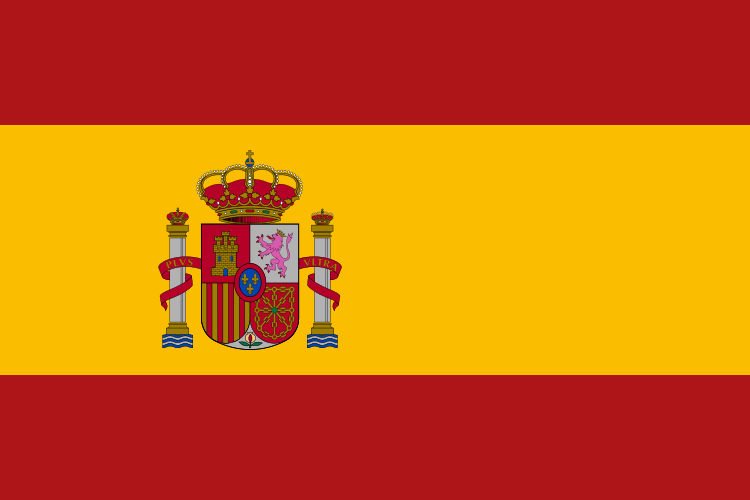
The Spain flag has three horizontal stripes: red, a double-width yellow band and red again, with the national coat of arms on the yellow stripe near the hoist. It began as a naval flag in 1785, chosen so ships could be recognized from afar.
What the flag of Spain looks like
The Spanish flag is made of three horizontal bands. The red bands at the top and bottom are each a quarter of the height, and the yellow band between them takes up the remaining half. The yellow is traditionally called gualda, a name that goes back to a plant used to make yellow dye. The usual proportions are 2:3.
The coat of arms is placed on the yellow band, shifted toward the hoist so it is not lost in the folds of a flying flag. The shield is divided into quarters showing the old kingdoms: a castle for Castile, a lion for León, red and gold bars for Aragon and chains for Navarre. A pomegranate for Granada sits at the point, and a small oval in the center carries the three fleurs-de-lis of the House of Bourbon. On either side stand the Pillars of Hercules, with a ribbon reading Plus Ultra ("further beyond"), and a royal crown tops the shield.
Spain has more than one version in practice. The flag with the coat of arms is the state flag. A plain red-yellow-red flag without the shield is widely used by citizens and for civil purposes. It is also seen at sporting events, sometimes with an unofficial emblem such as the Osborne bull in place of the arms.
Spain flag colors
Color codes measured from the official design. Use HEX for the web and CMYK for print.
HEX
#AD1519RGB
173, 21, 25CMYK
0, 88, 86, 32HEX
#FABD00RGB
250, 189, 0CMYK
0, 24, 100, 2Spain flag meaning and symbolism
The red and yellow of the Spanish flag are generally traced to the old flag of the Crown of Aragon, a yellow flag with red stripes, while the coat of arms on it is Castilian. There is no official explanation for the colors. Popular readings link the red to blood and courage and the yellow to the gold of the land, but these are interpretations, not part of the law.
The shield is where the symbolism is clearest. It shows the unification of the medieval kingdoms that form the modern state, with the Bourbon lilies added as a mark of the ruling dynasty. The Pillars of Hercules refer to the Strait of Gibraltar, and the motto Plus Ultra recalls the voyages to the Americas, since the older Latin warning said there was nothing beyond the Pillars.
Several regions of Spain use flags built on the same red and yellow, such as the red and yellow bars of Catalonia, which come from the old Aragonese arms. For other European flags, see flags of Europe.
History of the Spanish flag
For centuries Spain's ships sailed under white flags with the Bourbon arms, which looked much like the flags of other Bourbon states, including France. In 1785 King Charles III decreed a new naval ensign with a red-yellow-red design (the decree is dated 28 May 1785). The change was made so that Spanish vessels could be identified in battle, and the red and yellow were derived from the old Aragonese flag.
The red and yellow flag was used mostly by the navy for decades, until in 1843, under Isabella II, it was adopted by all the armed forces. During the First Republic (1873-74) the flag stayed much the same, apart from the removal of the crown. The Second Republic, proclaimed in 1931, added a purple-violet band to make a red-yellow-purple tricolor, which became a symbol of the republican side in the civil war.
The red-yellow-red flag was brought back by the Nationalist side during the civil war, and from 1938 it carried a coat of arms held by the eagle of Saint John. A slightly modified version of that eagle shield was adopted in 1977, and it was replaced by the current coat of arms in 1981, after the 1978 constitution said that the flag is red, yellow and red, with the yellow stripe twice the width of each red one.
Spain flag facts
| Country | Spain |
|---|---|
| Flag adopted | December 19, 1981 |
| Proportions | 2:3 |
| Colors | #AD1519, #FABD00 |
| Symbols | Coat of arms of Spain |
| Flag emoji | 🇪🇸 |
| Country code | ES, ESP (ISO 3166) |
| Capital | Madrid |
| Continent | Europe |
| Population | 48,592,909 |
| Area | 505,990 km² |
Spain flag: frequently asked questions
Are there two flags for Spain?
There are two common versions. The state flag shows the coat of arms on the yellow stripe, and the civil flag is the same three stripes without the shield. Both use the same colors and layout.
Why did Spain change its flag?
The red-yellow-red design was created in 1785 for the navy, and the colors have been the same since, apart from the Second Republic's purple stripe in 1931-39. Most changes affected only the coat of arms, after the Franco era in particular.
What flag is the 🇪🇸 emoji?
The 🇪🇸 emoji is the flag of Spain. Letter pairs make up flag emoji, and ES is Spain's country code. You can see it on the Spain flag emoji page.
Is the Spanish flag pink or purple?
Neither today: the Spanish flag is red, yellow and red. Purple (morado) appeared only on the flag of the Second Spanish Republic, a red, yellow and purple tricolor used from 1931 to 1939. The red-yellow-red flag was restored in 1936 by the Nationalists and is the design Spain uses now.
What was the original Spanish flag?
Spain had no single national flag before 1785. Ships flew white Bourbon flags with the royal arms, and armies used the red Cross of Burgundy, introduced after 1496. The current red-yellow-red design began as a naval ensign decreed by Charles III on 28 May 1785, chosen from 12 proposals.