Europe · EE / EST
Flag of Estonia
The Estonia flag is a horizontal tricolor of blue, black and white in stripes of equal size. It began as the banner of a student society in 1884 and became a symbol of Estonian independence, even though flying it was banned for decades under Soviet rule.

What the flag of Estonia looks like
The Estonian flag has three horizontal stripes of equal height: blue on top, black in the middle and white at the bottom. There is no emblem, coat of arms or other detail. The proportions are 7:11, so the flag is slightly narrower than the common 2:3 ratio.
Searches for a "square" Estonia flag usually come from icons and avatars. The real flag is rectangular. Only Switzerland and the Vatican City have square national flags. The Estonia flag emoji shows the same three stripes in a small size.
Estonia flag colors
Color codes measured from the official design. Use HEX for the web and CMYK for print.
HEX
#FFFFFFRGB
255, 255, 255CMYK
0, 0, 0, 0HEX
#0072CERGB
0, 114, 206CMYK
100, 45, 0, 19HEX
#000000RGB
0, 0, 0CMYK
0, 0, 0, 100Estonian flag meaning and symbolism
A popular interpretation, made well known by the poetry of Martin Lipp, which was set to music in 1922 as the song "Eesti lipp", has blue stand for the sky above Estonians, black for the attachment to the soil of their homeland, and white for purity, hard work and commitment.
The colors were adopted by the Estonian Students' Society in 1881, and each of the three was given a symbolic meaning. These readings are traditional interpretations.
History of the Estonian flag
Estonia was part of the Russian Empire when the flag was first used. The blue, black and white colors were adopted in 1881 by the Estonian Students' Society in Tartu, and the first flag was made in the spring of 1884 and consecrated in Otepää on 4 June of that year. It was at first a society flag, but it quickly grew into a symbol of the national awakening.
During the independence period the tricolor was officially approved. Estonia declared independence on 24 February 1918, and the government decided on 21 November 1918 that it would be the national flag, and a law passed in 1922 reconfirmed its status. It was the flag of the first republic until the Soviet occupation in 1940.
The Soviet authorities banned the tricolor and replaced it with the flag of the Estonian Soviet Socialist Republic. Estonians abroad kept using the flag, including the government-in-exile. In 1988, as the Singing Revolution gathered pace, the use of the old flag was allowed again. The tricolor was raised on Pikk Hermann tower in Tallinn on 24 February 1989, and it was formally re-adopted as the national flag in August 1990, a year before independence was fully restored in 1991.
Estonia celebrates Flag Day on 4 June, the date of the 1884 consecration. The flag is raised each morning on Pikk Hermann in Tallinn, and the Flag Act governs its use.
Estonian flag compared with its neighbors
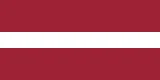
Estonia has close cultural ties with Finland and the Nordic countries, but its flag does not use a Nordic cross. Its southern neighbor Latvia flies a dark red flag with a narrow white stripe, and Finland uses a blue cross on white. See more designs on the European flags page.
Estonia flag facts
| Country | Estonia |
|---|---|
| Flag adopted | 1990 |
| Proportions | 7:11 |
| Colors | #FFFFFF, #0072CE, #000000 |
| Flag emoji | 🇪🇪 |
| Country code | EE, EST (ISO 3166) |
| Capital | Tallinn |
| Continent | Europe |
| Population | 1,369,995 |
| Area | 45,335 km² |
| National anthem | Mu isamaa, mu õnn ja rõõm |
Estonia flag: frequently asked questions
What does the Estonian flag symbolize?
A popular interpretation links blue to the sky above Estonians, black to the soil of their homeland, and white to purity, hard work and commitment.
Why is Estonia's flag like that?
The colors come from the banner of the Estonian Students' Society, consecrated in 1884. It became the national flag in 1918 and was re-adopted in 1990 after being banned by the Soviet authorities.
Which countries have a square flag?
Switzerland and the Vatican City. Estonia's flag is rectangular, with a ratio of 7:11, but it is often shown in a square shape on icons.
What country was Estonia before?
Estonia was part of the Russian Empire until it declared independence on 24 February 1918. From 1940 to 1991 it was the Estonian Soviet Socialist Republic, and the blue, black and white flag was banned in that period. The tricolor was officially re-adopted in August 1990.
What are the colors of the Estonian flag?
The colors are blue, black and white, from top to bottom, in three stripes of equal size.