Oceania · VU / VUT
Flag of Vanuatu
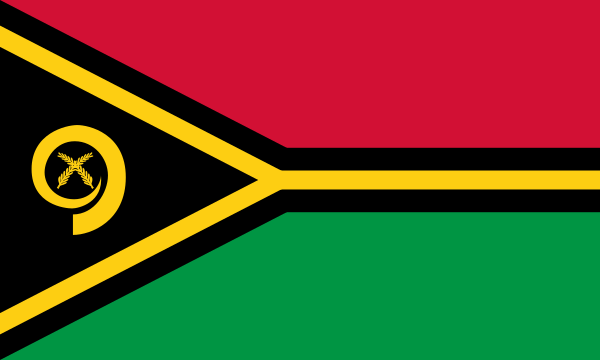
The Vanuatu flag has a red upper band and a green lower band, a black triangle at the hoist and a sideways yellow Y. In the triangle sits a curved boar's tusk with two crossed namele leaves.
What the flag of Vanuatu looks like
The national flag of Vanuatu has a ratio of 3:5 and is split horizontally into a red band on top and a green band below. At the hoist is a black isosceles triangle. A yellow horizontal Y-shaped band, edged around the black triangle, has its two arms starting at the upper and lower hoist corners and meeting along the border between the red and green fields, from where a single stripe continues toward the fly. Its shape is said to reflect the layout of the island chain.
Inside the black triangle is a yellow emblem: a curved boar's tusk, and across it two crossed leaves of the namele tree. The flag therefore uses four colors, green, red, black and yellow, and the emblem is the only picture on it.
Vanuatu flag colors
Color codes measured from the official design. Use HEX for the web and CMYK for print.
HEX
#009543RGB
0, 149, 67CMYK
100, 0, 55, 42HEX
#D21034RGB
210, 16, 52CMYK
0, 92, 75, 18HEX
#000000RGB
0, 0, 0CMYK
0, 0, 0, 100HEX
#FDCE12RGB
253, 206, 18CMYK
0, 19, 93, 1Vanuatu flag meaning and symbolism
The colors are explained in the following way. Red represents the blood that unites humanity. Green stands for the richness of the islands' land. Black refers to the Melanesian people of Vanuatu (the ni-Vanuatu). The yellow Y stands for the light of the Gospel, a nod to the Christian faith of most people in the country. The yellow and black edging around the triangle was added at the request of Prime Minister Walter Lini to make the black stand out.
The Y shape represents the shape of the islands on the map. The boar's tusk is a symbol of custom and tradition and also of prosperity, and it is worn as a pendant on the islands. The two namele leaves are a token of peace, and their 39 leaflets stand for the 39 original members of the Parliament of Vanuatu. There is no Bible on the flag: that question is sometimes asked in error, and the Dominican Republic is the country that places a Bible on its flag.
History of the Vanuatu flag
Vanuatu was called the New Hebrides during the colonial period and was ruled jointly by Britain and France as a condominium. In 1977 the local artist Kalontas Malon designed a flag in almost the same colors and symbolism for the Vanua'aku Pati, the leading independence party. When the party led the country to independence, its colors (red, green, black and yellow) became the basis for the national flag, and a parliamentary committee chose the final design from submissions by local artists. The flag was adopted on 18 February 1980, a few months before independence on 30 July 1980.
The flag has not changed since. Vanuatu is a member of the Commonwealth and the Francophonie, and its official languages are Bislama, English and French. The flag is flown across the country on Independence Day, a national holiday.
You can also see the flag as an emoji on the Vanuatu flag emoji page, and find other national flags in the Oceania list.
Vanuatu flag facts
| Country | Vanuatu |
|---|---|
| Flag adopted | February 18, 1980 |
| Proportions | 3:5 |
| Colors | #009543, #D21034, #000000, #FDCE12 |
| Symbols | fern, tusk |
| Flag emoji | 🇻🇺 |
| Country code | VU, VUT (ISO 3166) |
| Capital | Port Vila |
| Continent | Oceania |
| Population | 300,019 |
| Area | 12,190 km² |
| Currency | Vanuatu vatus |
| National anthem | Yumi, Yumi |
Vanuatu flag: frequently asked questions
What is the old name of Vanuatu?
Before independence in 1980, Vanuatu was known as the New Hebrides, a name given by the British explorer James Cook. It was run jointly by Britain and France.
What does the Vanuatu flag look like?
It has a red band over a green band, a black triangle at the hoist, and a yellow horizontal Y. The black triangle holds a yellow boar's tusk with two crossed namele leaves.
Which country is Vanuatu in?
Vanuatu is an independent island country in the South Pacific, in the region of Melanesia, about 1,750 kilometres east of Australia. Its capital is Port Vila.
Is Vanuatu a French territory?
No. Vanuatu was jointly governed by France and Britain until it became independent on 30 July 1980. It remains a member of the Francophonie, and French is one of its official languages.
What do the colors of the Vanuatu flag mean?
Green represents the richness of the islands, red the blood that unites humanity, and black the Melanesian ni-Vanuatu people. The yellow Y-shape stands for the shape of the islands on the map and for the light of the gospel.
What do the boar's tusk and namele leaves on the Vanuatu flag mean?
The boar's tusk is a symbol of custom, tradition and prosperity and is worn as a pendant on the islands. The two namele leaves are a token of peace, and their 39 leaflets stand for the original 39 members of Parliament.
When was the Vanuatu flag adopted and who designed it?
The flag was adopted on 18 February 1980, before independence on 30 July 1980. It was based on a 1977 party flag by the local artist Kalontas Malon, and a parliamentary committee chose the final design from submissions by local artists.