Oceania · SB / SLB
Flag of the Solomon Islands
The Solomon Islands flag is divided by a thin yellow diagonal stripe into a blue triangle at the top and a green triangle below. Five white stars sit in the blue triangle, one for each of the provinces the country was divided into at independence.
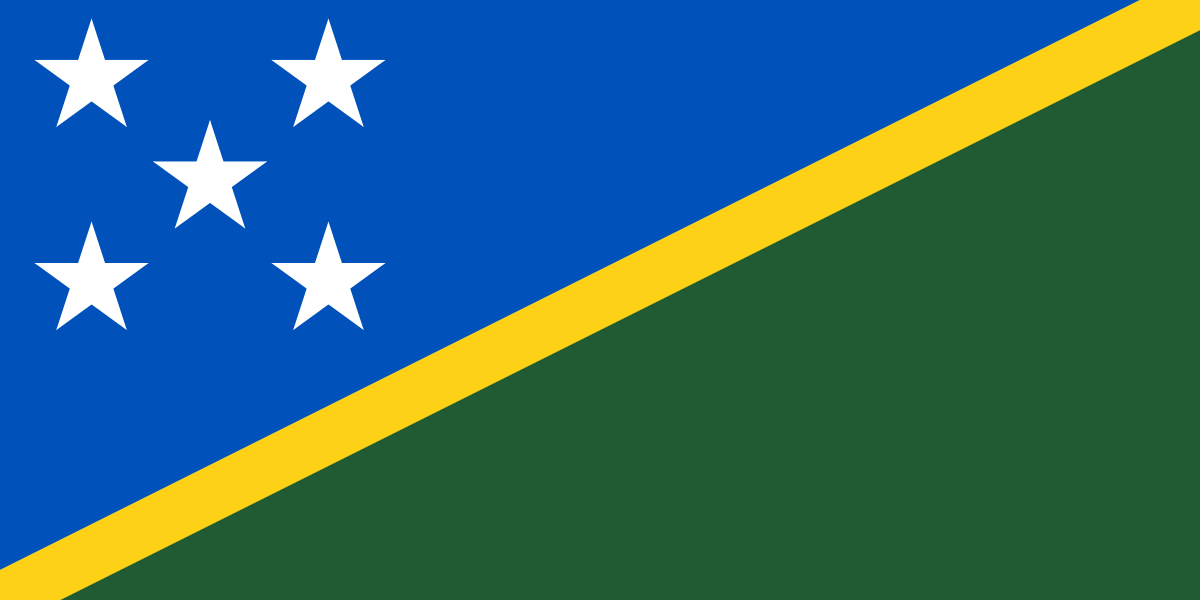
What the flag of the Solomon Islands looks like
The flag has a 1:2 ratio and is cut by a narrow yellow stripe that runs from the lower hoist corner (next to the pole) up to the upper fly corner. The blue triangle lies above the stripe, along the hoist and top edge. The green triangle lies below, toward the fly.
The five white stars sit in the blue triangle in the upper hoist corner, arranged in three offset rows in the shape of the letter X.
Solomon Islands flag colors
Color codes measured from the official design. Use HEX for the web and CMYK for print.
HEX
#215B33RGB
33, 91, 51CMYK
64, 0, 44, 64HEX
#0051BARGB
0, 81, 186CMYK
100, 56, 0, 27HEX
#FCD116RGB
252, 209, 22CMYK
0, 17, 91, 1HEX
#FFFFFFRGB
255, 255, 255CMYK
0, 0, 0, 0Solomon Islands flag meaning and symbolism
The meanings are:
- Blue for the water, including the rivers, the rain and the Pacific Ocean.
- Green for the land, with its trees and crops.
- Yellow for the sun and its rays, which separate the land and the ocean.
- The five stars for the five provinces at the time of independence: Central, Western, Eastern, Malaita and Honiara Capital.
The country now has nine provinces, plus the capital territory of Honiara, but the number of stars was not changed.
History of the Solomon Islands flag
The British declared a protectorate over the southern Solomon Islands in 1893, and later took over the northern part from Germany. Under British rule, the flag was a Blue Ensign (a blue flag with the Union Jack in the corner) defaced with the arms of the protectorate.
A contest to design a new flag was held in 1975. Earlier winning designs were scrapped, and the final design was created by a New Zealander teaching art at the King George VI School in Honiara. It was ratified on 18 November 1977, and the islands became independent on 7 July 1978. The flag has not changed since. The Solomon Islands remain in the Commonwealth, and the British monarch is head of state.
The flag appears on the flag emoji and at national events, and it can be compared with the other Pacific flags on the Oceania page.
Solomon Islands flag facts
| Country | Solomon Islands |
|---|---|
| Flag adopted | November 18, 1977 |
| Proportions | 1:2 |
| Colors | #215B33, #0051BA, #FCD116, #FFFFFF |
| Symbols | five-pointed star |
| Flag emoji | 🇸🇧 |
| Country code | SB, SLB (ISO 3166) |
| Capital | Honiara |
| Continent | Oceania |
| Population | 611,343 |
| Area | 28,400 km² |
| Currency | Solomon Islands dollar |
| National anthem | God Save Our Solomon Islands |
Solomon Islands flag: frequently asked questions
What does the Solomon Islands flag mean?
Blue is for the ocean, green for the land, and yellow for the sun. The five stars stand for the five provinces at the time of independence.
Is the Solomon Islands a British colony?
Not any more. It was a British protectorate until independence on 7 July 1978. It is now an independent country that keeps the British monarch as head of state.
What continent do the Solomon Islands belong to?
They are in Oceania, in the southwest Pacific Ocean, east of Papua New Guinea. The capital is Honiara, on the island of Guadalcanal.