North America · PM / SPM
Flag of Saint Pierre and Miquelon
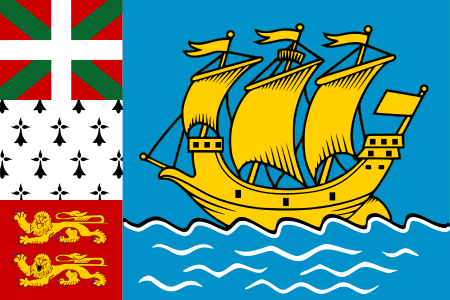
The flag of Saint Pierre and Miquelon shows a golden sailing ship on a blue field, with the flags of the Basque Country, Brittany and Normandy stacked at the hoist. It is an unofficial local flag, widely used on the islands off Newfoundland, while the French tricolor is the official flag.
Which flag does Saint Pierre and Miquelon use?
Saint Pierre and Miquelon is a French overseas collectivity of about 6,000 people, lying a short distance off the south coast of Newfoundland in Canada. As part of France, its official flag is the French tricolor (see the flag of France), and French law gives it precedence over other flags.
The flag shown on this page is the local flag. French law neither authorizes nor prohibits it: it appears on official documents and flies below the French flag in front of the Territorial Council building, and civilian vessels use it as a civil ensign. The town halls of Saint-Pierre and Miquelon-Langlade fly only the French flag.
St. Pierre & Miquelon flag colors
Color codes measured from the official design. Use HEX for the web and CMYK for print.
HEX
#0092C8RGB
0, 146, 200CMYK
100, 27, 0, 22HEX
#FFCF00RGB
255, 207, 0CMYK
0, 19, 100, 0HEX
#FFFFFFRGB
255, 255, 255CMYK
0, 0, 0, 0HEX
#CC0000RGB
204, 0, 0CMYK
0, 100, 100, 20HEX
#08672FRGB
8, 103, 47CMYK
92, 0, 54, 60HEX
#010101RGB
1, 1, 1CMYK
0, 0, 0, 100HEX
#AB8B00RGB
171, 139, 0CMYK
0, 19, 100, 33HEX
#221D02RGB
34, 29, 2CMYK
0, 15, 94, 87What the flag looks like
The flag is a blue field with a yellow silhouette of a sailing ship, the Grande Hermine. At the hoist, three regional flags are arranged vertically: the Basque flag (the Ikurriña), the Breton flag with its ermine canton (Brittany), and the flag of Normandy, in that order from top to bottom.
The mix of eight measured colors is unusual for a territorial flag, and the regional flags make it easy to recognize. Compare it with the plain tricolor shown in the Saint Pierre and Miquelon flag emoji.
Meaning and symbolism
The ship is the Grande Hermine, on which the French explorer Jacques Cartier first reached the island of Saint Pierre on 15 June 1536. The three regional flags represent the places that most of the islands' residents trace their ancestry to: the Basque Country, Brittany and Normandy.
History of the flag and the islands
Jacques Cartier claimed the islands for France in 1536, and the first permanent French settlers arrived in the late 17th century. The islands changed hands between France and Britain several times in the 18th and early 19th centuries, and France returned for good in 1816. They are the only remaining French territory in North America. They became an overseas department in 1976, a special territorial collectivity in 1985, and an overseas collectivity after the French constitutional reform of 2003.
The local flag was created in the 1980s by a local resident, André Paturel, who simplified the islands' coat of arms (designed in the 1960s by Léon Joner) into a flag. It is widely used but has never replaced the tricolor in official use.
St. Pierre & Miquelon flag facts
| Country | St. Pierre & Miquelon |
|---|---|
| Proportions | 2:3 |
| Colors | #0092C8, #FFCF00, #FFFFFF, #CC0000, #08672F, #010101, #AB8B00, #221D02 |
| Flag emoji | 🇵🇲 |
| Country code | PM, SPM (ISO 3166) |
| Capital | Saint-Pierre |
| Continent | North America |
| Population | 5,974 |
| Area | 242 km² |
| National anthem | La Marseillaise |
St. Pierre & Miquelon flag: frequently asked questions
Why do Saint Pierre and Miquelon have a Basque flag?
The Basque flag is one of three regional flags on the local flag, along with those of Brittany and Normandy. They honor the regions the islands' settlers and fishermen came from, and many residents have Basque ancestry.
What country does Saint-Pierre belong to?
Saint Pierre and Miquelon belongs to France. It is an overseas collectivity, and its residents are French citizens who vote in French elections.
Why does France still own Saint Pierre and Miquelon?
France has held the islands since the 1500s, apart from periods of British control, and has held them continuously since 1816. The residents are French citizens, and the islands' status as a French territory has remained in place.
Is Saint Pierre and Miquelon a country?
No. It is an overseas collectivity of France and part of the French Republic. Its official flag is the French tricolor.
Do Americans need a passport to go to Saint Pierre and Miquelon?
Generally yes, because the islands are a French territory outside both the United States and Canada. Check current entry rules before traveling. The islands lie a short distance off Newfoundland, with a ferry link to Fortune.