Europe · GB-SCT
Flag of Scotland
The Scotland flag is the Saltire, a white diagonal cross on a blue field, also called the St Andrew's Cross. A legend traces it to a cloud pattern seen in the sky before a medieval battle, and its use is recorded from the 16th century.
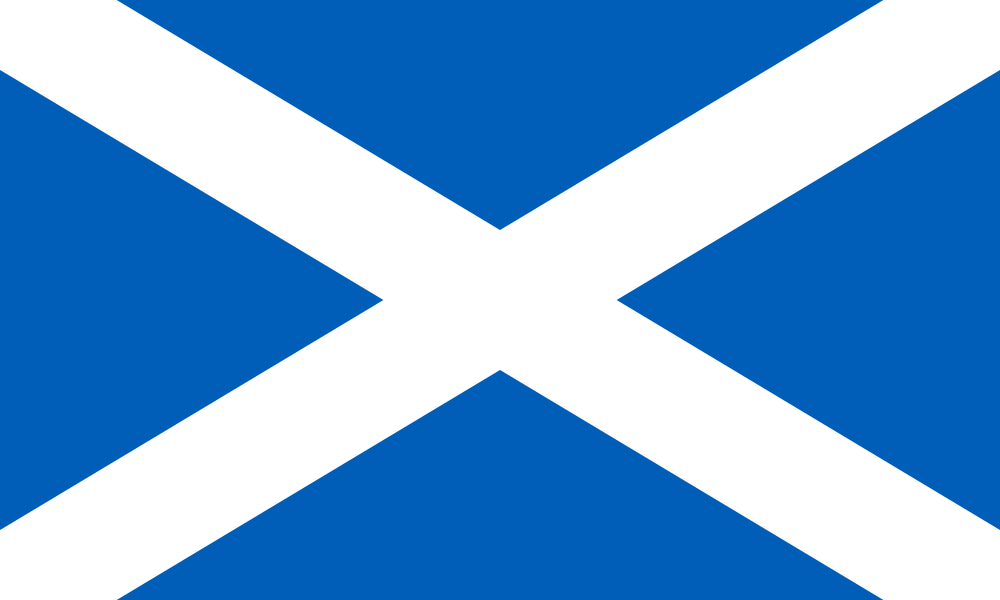
What the flag of Scotland looks like
The flag of Scotland has a blue background crossed by a white X-shaped cross that reaches the corners. In heraldry this diagonal cross is called a saltire, which is why the flag is known as the Saltire. The proportions are not fixed, but 3:5 is the most common.
The shade of blue has varied over the centuries, from light sky blue to dark navy. In 2003 a committee of the Scottish Parliament recommended Pantone 300, a lighter blue than the Union Flag's Pantone 280, as the best shade, and recent flags have largely followed it, though many are made in other shades. The white is plain. The Saltire is a very simple design with no emblem, and it is the basis of the flag of Nova Scotia (with the colors reversed) and one of the three crosses in the Union Flag. See the Scotland flag emoji for the small version.
Scotland flag colors
Color codes measured from the official design. Use HEX for the web and CMYK for print.
HEX
#005EB8RGB
0, 94, 184CMYK
100, 49, 0, 28HEX
#FFFFFFRGB
255, 255, 255CMYK
0, 0, 0, 0Scotland flag meaning and symbolism
The white cross is the cross of Saint Andrew, the patron saint of Scotland. According to tradition, Andrew was an apostle who was crucified on an X-shaped cross, and this is why the X shape is linked to him. The blue is often said to represent the sky, in the legend of the flag's origin.
According to legend, the Saltire originated on the eve of the Battle of Athelstaneford in East Lothian in 832. In the usual telling, King Óengus (Angus) of the Picts prayed the night before the battle, and in the morning a white cloud formed a diagonal cross against a blue sky. It was taken as a sign of Saint Andrew's help. It is a legend, but Athelstaneford calls itself the birthplace of the flag, and has a Flag Heritage Centre.
History of the Scottish flag
Saint Andrew became associated with Scotland in the Middle Ages: the 1320 Declaration of Arbroath names him, and the saint appears on Scottish seals from 1180 onwards. In 1385 the Parliament of Scotland decreed that every Scottish and French soldier fighting the English should wear a sign before and behind, a white St Andrew's Cross. A white saltire on blue is recorded as a naval flag in 1507, on the carrack Great Michael, and it is shown as a heraldic flag in 1542.
When James VI of Scotland became king of England in 1603, the Saltire was combined with the English cross of Saint George in the first Union Flag of 1606. The Saltire has been one of its elements ever since, along with the red saltire of Saint Patrick, added in 1801 for Ireland. Scots objected to the 1606 design because the cross of Saint George lay over that of Saint Andrew, and a Scottish variant was reportedly used on ships. Today the Saltire is the correct flag for private individuals and companies, and Scottish Government rules say it should fly on its buildings every day from 8 a.m. until sunset where possible, except on certain UK national days.
Saint Andrew's Day on 30 November is Scotland's official national day, and it is a flag day.
The Lion Rampant and the Royal Banner of Scotland
Scotland is often said to have two flags. The second is the Royal Banner of Scotland, also called the Lion Rampant: a yellow field with a red lion standing on its hind legs and surrounded by a double border decorated with fleurs-de-lis. It is the royal arms of the Scottish monarchs, and its correct use is restricted by an Act of the Parliament of Scotland to a few Great Officers of State who represent the Sovereign in Scotland.
That is why people say that flying the Lion Rampant is illegal. In practice, a 1934 Royal Warrant allowed hand-held versions to be waved, and the Lion Rampant is commonly seen at sports matches and other public occasions. The Saltire is the national flag, and the Lion Rampant is a royal banner. The unicorn is also linked to Scotland as a heraldic animal: two unicorns hold the shield on the royal arms of Scotland, but there is no unicorn flag.
Scotland flag facts
| Country | Scotland |
|---|---|
| Flag adopted | 1542 |
| Proportions | 3:5 |
| Colors | #005EB8, #FFFFFF |
| Symbols | saltire |
| Flag emoji | 🏴 |
| Country code | GB-SCT (ISO 3166) |
| Capital | Edinburgh |
| Continent | Europe |
| Population | 5,404,700 |
| Area | 78,782 km² |
| Currency | pound sterling |
| National anthem | Flower of Scotland |
Scotland flag: frequently asked questions
What are the two flags of Scotland?
The national flag is the Saltire, a white diagonal cross on blue. The second is the Royal Banner of Scotland (the Lion Rampant), a red lion on a yellow field, which is the royal banner and is restricted to official use.
Which is the correct Scottish flag?
The Saltire is the national flag of Scotland and the one anyone can fly. The Lion Rampant is the royal banner, and its correct use is restricted, although hand-held versions are commonly waved at sports events.
What color is the Scottish flag?
Blue and white. The background is blue, and the Saint Andrew's cross is white. A Scottish Parliament committee recommended Pantone 300 as the best shade of blue.
What was the old Scotland flag?
The Saltire is recorded as a naval flag in 1507 and as a heraldic flag in 1542. The historic Scottish Red Ensign was last used officially by the pre-Union Royal Scots Navy and merchant ships in the 18th century.
Can you fly the Scottish flag in Scotland?
Yes. The Saltire is the national flag and anyone may fly it. Scottish Government rules say it should fly on its buildings every day from 8 a.m. until sunset where possible, except on certain UK national days.
What does the Saltire cross symbolize?
The white diagonal cross is the cross of Saint Andrew, Scotland's patron saint, who tradition says was crucified on an X-shaped cross. A legend says a white cloud formed this cross in a blue sky before the Battle of Athelstaneford in 832, which explains the blue.
Is a unicorn Irish or Scottish?
The unicorn is a Scottish heraldic symbol. Two unicorns support the shield on the royal arms of Scotland, and the national flag remains the blue and white Saltire.