Europe · BA / BIH
Flag of Bosnia and Herzegovina
The flag of Bosnia and Herzegovina is blue with a yellow right-angled triangle and a diagonal line of white stars. It was introduced in 1998 and was designed to be neutral, so that no ethnic group would be favored.
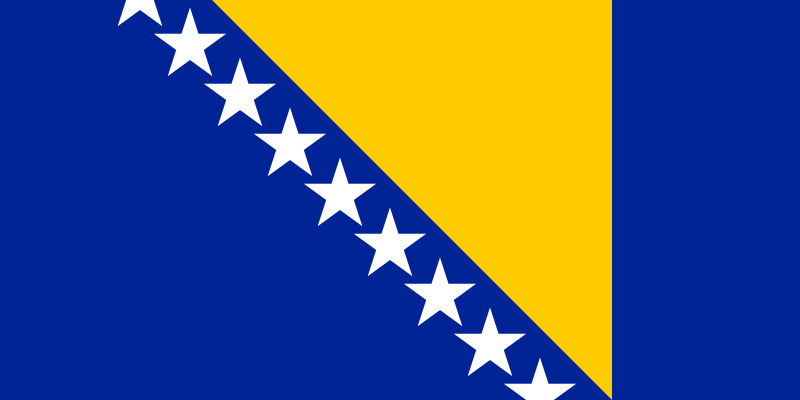
What the Bosnia and Herzegovina flag looks like
The flag has a blue field with a width-to-height ratio of 2:1. On it is a large yellow right-angled triangle. Along the longest side of the triangle, the diagonal one, runs a row of white five-pointed stars. There are nine stars in total: seven full stars and two half stars at the top and bottom, cut off by the edges of the flag, which suggests that the line of stars continues beyond the flag.
The colors are blue, yellow and white. The blue is evocative of the flag of Europe, and white, blue and yellow are colors often associated with neutrality and peace. The yellow triangle is the feature that makes the flag easy to recognize at a glance. You can see it in reduced form in the Bosnia and Herzegovina flag emoji.
Bosnia & Herzegovina flag colors
Color codes measured from the official design. Use HEX for the web and CMYK for print.
HEX
#002395RGB
0, 35, 149CMYK
100, 77, 0, 42HEX
#FECB00RGB
254, 203, 0CMYK
0, 20, 100, 0HEX
#FFFFFFRGB
255, 255, 255CMYK
0, 0, 0, 0Bosnia and Herzegovina flag meaning and symbolism
The three corners of the triangle are commonly said to stand for the three constituent peoples of the country: Bosniaks, Croats and Serbs. The triangle also represents the approximate shape of the territory of Bosnia and Herzegovina. The stars represent Europe and are meant to be infinite in number, which is why they continue off the edges of the flag. The blue background is evocative of the flag of Europe.
The flag was chosen with a political aim. Aside from the colors, it has no historical or other references to the Bosnian state, and it uses no symbol tied to a single ethnic group. The colors are also traditionally associated with Bosnian culture and history.
History of the Bosnia and Herzegovina flag
The medieval Kingdom of Bosnia used the royal symbol of the Kotromanic dynasty, a shield with golden lilies on a blue field. During the Ottoman period and under Austria-Hungary, which annexed the country in 1908, Bosnia and Herzegovina had various banners and arms. After the Second World War, Bosnia and Herzegovina became a republic within federal Yugoslavia. Its flag, adopted on 31 December 1946, was red with the Yugoslav tricolor in the canton.
When the country declared independence in 1992, it adopted a new flag on 20 May 1992, a white field with a blue shield and six golden lilies, drawn from the arms of the medieval Kotromanic kings. Many Bosnian Serbs saw it as representing only the Bosniaks, and the war that followed ended with the Dayton Agreement in 1995. The agreement created a state made up of two entities, the Federation of Bosnia and Herzegovina and Republika Srpska.
The state needed a common flag, and parliament could not agree on one. In February 1998, the High Representative for Bosnia and Herzegovina, Carlos Westendorp, imposed the present design, which was one of the proposals drafted with international support. It replaced the lily flag on 4 February 1998. The two entities also have their own flags.
Flags that look like Bosnia's flag
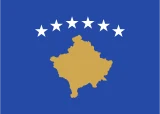
A similar flag is that of Kosovo, which is blue with a gold map of the country and a row of six white stars. Both flags combine a blue field, yellow and white stars. The Bosnian flag is also sometimes confused with that of Ukraine because of the blue and yellow colors, but the layout is completely different.
Bosnia & Herzegovina flag facts
| Country | Bosnia and Herzegovina |
|---|---|
| Flag adopted | February 4, 1998 |
| Proportions | 1:2 |
| Colors | #002395, #FECB00, #FFFFFF |
| Symbols | five-pointed star |
| Flag emoji | 🇧🇦 |
| Country code | BA, BIH (ISO 3166) |
| Capital | Sarajevo |
| Continent | Europe |
| Population | 3,816,459 |
| Area | 51,209 km² |
| Currency | convertible mark, Bosnia and Herzegovina dinar |
| National anthem | National Anthem of Bosnia and Herzegovina |
Bosnia & Herzegovina flag: frequently asked questions
Why did Bosnia and Herzegovina change its flag?
The 1992 flag, with golden lilies, was linked to one ethnic group and was not accepted by all. A new neutral flag was imposed in 1998 by the High Representative after the parliament failed to agree.
What does the flag of Bosnia and Herzegovina mean?
The triangle stands for the three main peoples, Bosniaks, Croats and Serbs, and roughly the shape of the country. The stars represent Europe, and the blue is evocative of the flag of Europe.
Does Bosnia and Herzegovina have two flags?
There is one state flag, adopted in 1998. The Federation of Bosnia and Herzegovina and Republika Srpska, the two entities, have their own flags. In Republika Srpska, many residents prefer to fly the entity's flag or the Serbian flag.
Are Bosnia and Herzegovina two countries?
No, it is one country. The name comes from two historical regions, Bosnia in the north and center and Herzegovina in the south.
Which country has three presidents?
Bosnia and Herzegovina. Its Presidency has three members, one Bosniak, one Croat and one Serb, who take turns as chair.
What country did Bosnia belong to?
Before independence, Bosnia and Herzegovina was a socialist republic within Yugoslavia. It declared independence on 3 March 1992. Earlier it was ruled by the Ottoman Empire from 1463 and then annexed by Austria-Hungary.
What are the proportions of the flag of Bosnia and Herzegovina?
The flag has an official aspect ratio of 1:2, so it is twice as long as it is tall. A blue field is divided by a yellow right-angled triangle, and the stars run along its long side.
How many stars are on the Bosnia and Herzegovina flag?
Seven full five-pointed white stars and two half stars, one at the top and one at the bottom. The stars are meant to be infinite in number, so they continue beyond the edges of the flag.