U.S. state · AR
Flag of Arkansas
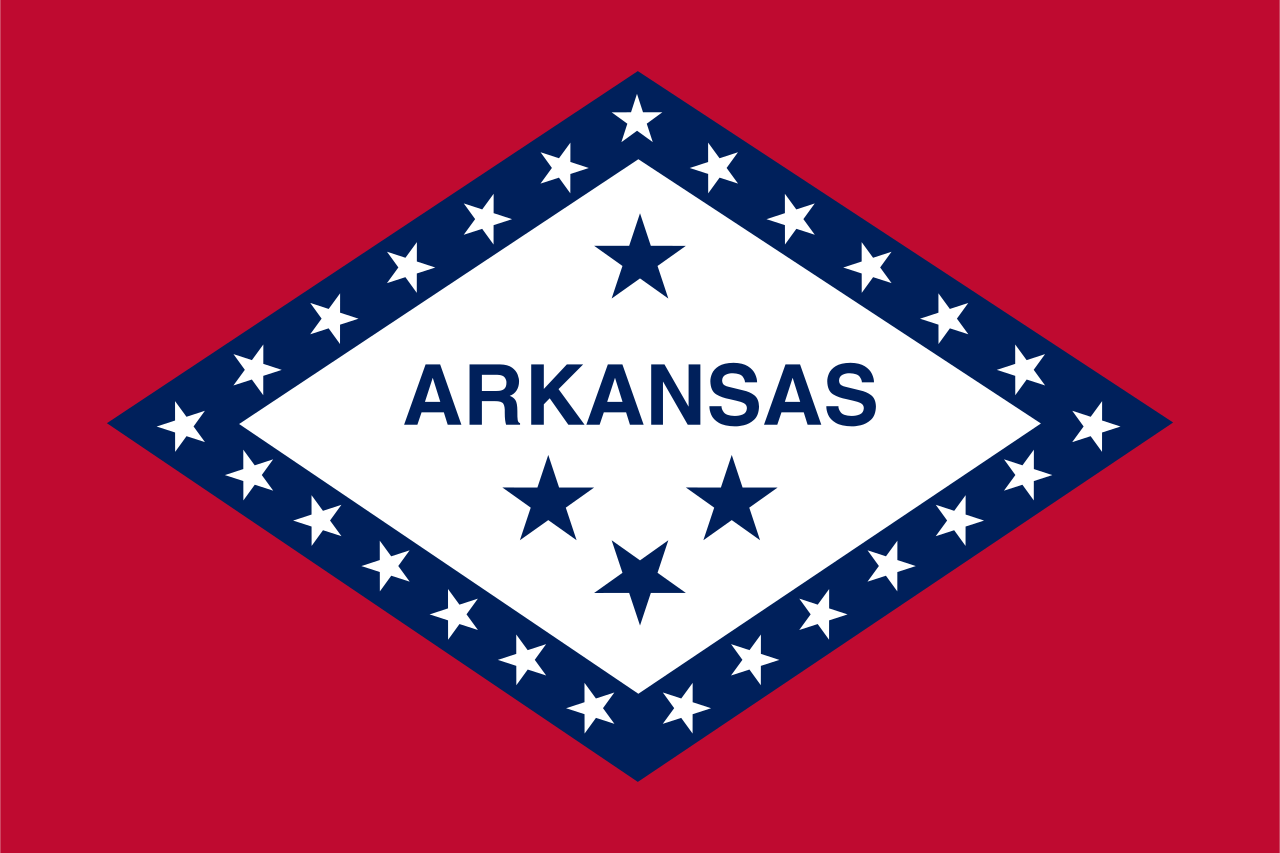
The Arkansas flag is a red field with a large white diamond edged in blue. The word ARKANSAS and four blue stars sit inside the diamond, and 25 white stars ring its border. It was designed by Willie Kavanaugh Hocker in 1912.
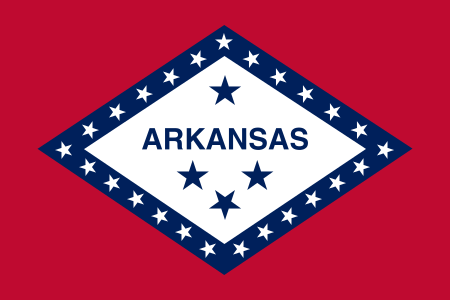
What the Arkansas state flag looks like
The state flag of Arkansas has a red field with a white diamond in the center. A wide blue band runs around the inside of the diamond, and it carries 25 white stars. In the white center is the word ARKANSAS in blue capital letters. One blue star sits above the name, and three blue stars sit below it.
The colors are the same as those on the U.S. flag, Old Glory Red and Old Glory Blue, along with white. Among state flags, Arkansas is unusual in being built around a diamond.
Arkansas flag meaning and symbolism
The pieces of the design have specific meanings:
- The diamond recalls the fact that Arkansas has the only diamond-producing site in the country that is open to the public, the Crater of Diamonds near Murfreesboro.
- The 25 white stars mark Arkansas as the 25th state to join the Union, in 1836.
- The four blue stars are tied to the area's history of changing governments. The original three are explained as Spain, France and the United States, and a fourth star was added in 1923 and placed above the name in 1924.
- Red, white and blue echo the national colors.
History of the Arkansas flag
Arkansas had no official flag until the early 20th century. In 1912 a state flag contest was organized, with the Daughters of the American Revolution among those involved. Of 65 entries, the winner came from Willie Kavanaugh Hocker, a member of the Pine Bluff Chapter of the Daughters of the American Revolution from Wabbaseka. Her design was adopted by the legislature on February 26, 1913.
Hocker's first version had a diamond and three blue stars. In 1923 the legislature added a fourth blue star, first placed so that two stars sat above the name and two below. In 1924 the legislature moved it above the name, with the original three below, which is the layout used today. The 1924 design was confirmed in law in 1987.
Interesting facts
- The state motto, Regnat populus, means "the people rule."
- The flag combines two sets of stars: 25 white ones on the border and four blue ones in the center.
- In a 2001 survey by the North American Vexillological Association, the Arkansas flag ranked 45th out of 72 North American flags in design quality.
You can compare the design with other states in our list of U.S. state flags, such as Alabama, or the flag of the United States.
Arkansas flag colors
#BF0A30RGB
191, 10, 48CMYK
0, 95, 75, 25#FFFFFFRGB
255, 255, 255CMYK
0, 0, 0, 0#00205BRGB
0, 32, 91CMYK
100, 65, 0, 64Arkansas flag facts
| Adopted | 1924 |
|---|---|
| Proportions | 2:3 |
| Designer | Willie Kavanaugh Hocker |
| State capital | Little Rock |
| State motto | Regnat populus |
| Population | 3,011,524 |
Arkansas state flag FAQ
What do the four blue stars on the Arkansas flag mean?
They are tied to the governments that have ruled the area. The original three are explained as Spain, France and the United States. A fourth blue star was added in 1923 and placed above the name in 1924.
Who designed the Arkansas flag?
Willie Kavanaugh Hocker of Wabbaseka designed it. Her entry won a state flag contest in 1912, and the legislature adopted it on February 26, 1913.
When did Arkansas change its flag?
The flag was adopted on February 26, 1913. It was modified in 1923, when a fourth blue star was added, and the star was moved above the name in 1924.
What does the diamond on the Arkansas flag mean?
The diamond represents the Crater of Diamonds, the only public diamond site in the United States where visitors can keep what they find.
Why does the Arkansas flag have 29 stars?
The 29 stars are two sets. Twenty-five white stars on the blue border mark Arkansas as the 25th state. Four blue stars sit inside the white diamond, one above the word ARKANSAS and three below. The three original blue stars are explained as Spain, France and the United States, and the fourth was added in 1923 and moved above the name in 1924.