U.S. state · AL
Flag of Alabama
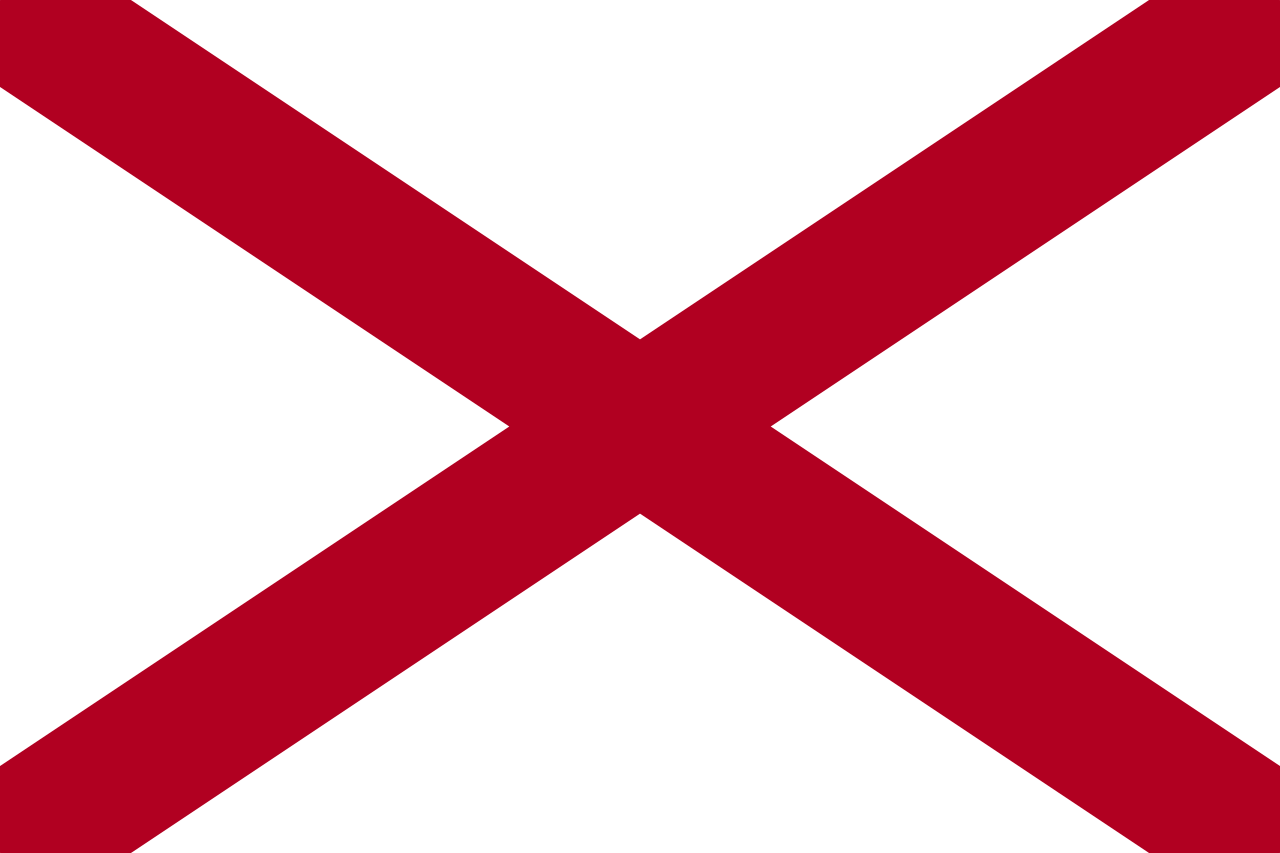
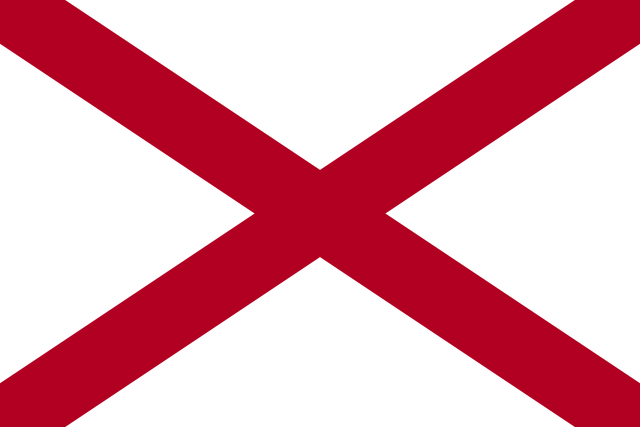
The Alabama flag is a white field crossed by a crimson diagonal cross, or saltire, and nothing else. Adopted in 1895, it is one of the simplest state flags in the United States, using only two colors and no seal or text.
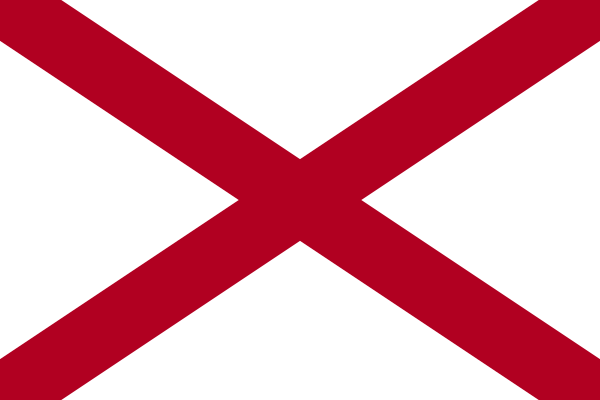
What the Alabama state flag looks like
The state flag of Alabama is a white rectangle with a crimson cross of St. Andrew, a saltire made of two bars that run diagonally from the corners. State law says the bars must be at least six inches wide and must extend all the way from corner to corner.
There is no seal, star, motto or lettering. That makes it very easy to recognize from a distance and easy to reproduce. The flag uses just two colors, red (officially crimson) and white.
Alabama flag meaning and symbolism
The law that created the flag does not assign a meaning to the crimson or the white, so there is no official symbolism. The cross itself is a St. Andrew's cross, a shape that appears on many flags, including the flag of Scotland and the flag of Florida.
The St. Andrew's cross is an old heraldic shape. Alabama's version is a plain crimson cross on a white field, with no stars, seal or lettering.
The state's motto, Audemus jura nostra defendere ("We dare defend our rights"), appears on the state coat of arms and seal rather than on the flag.
History of the Alabama flag
Alabama had no official state flag before 1895, though various unofficial banners were flown in the 19th century.
The current flag was adopted by the state legislature on February 16, 1895. It was proposed by John W. A. Sanford Jr., a state representative. He introduced the bill together with a model of the flag. The law has not changed in more than a century, and it has never said whether the flag must be square or rectangular; a 1987 letter from the state Attorney General's office said it is rectangular.
Flag rules and interesting facts
- Alabama's flag is often confused with Florida's, which also uses a red saltire on white. The Florida flag adds the state seal in the middle.
- Alabama's flag has no front or back. The design is identical on both sides.
- The flag was adopted by Act 383 of the Alabama Legislature, and the law requires the bars to be at least six inches wide, so very small copies do not meet the legal definition.
To compare it with other state banners, browse all U.S. state flags or see the flag of the United States.
Alabama flag colors
#FFFFFFRGB
255, 255, 255CMYK
0, 0, 0, 0#B10021RGB
177, 0, 33CMYK
0, 100, 81, 31Alabama flag facts
| Adopted | February 16, 1895 |
|---|---|
| Proportions | 2:3 |
| Designer | John W. A. Sanford Jr. |
| Symbols | saltire |
| State capital | Montgomery |
| State motto | Audemus jura nostra defendere |
| Population | 5,024,279 |
Alabama state flag FAQ
What does the Alabama flag symbolize?
The law does not give the colors or the cross an official meaning. The crimson cross of St. Andrew on white is a traditional heraldic design.
What is the cross on the Alabama flag called?
It is a saltire, also called the cross of St. Andrew: a diagonal cross whose bars run from corner to corner. Alabama's is crimson on a white field, and the law requires the bars to be at least six inches wide.
When did Alabama change its state flag?
Alabama has not changed its flag since 1895. The legislature adopted it on February 16, 1895, and the state had no official flag before that.
Who designed the Alabama flag?
The design is credited to John W. A. Sanford Jr., a state representative who introduced the bill to the legislature in 1895.
What are the colors of the Alabama flag?
The flag uses two colors: crimson (a deep red) and white. The crimson forms the diagonal cross, and white fills the rest of the flag.