U.S. state · MD
Flag of Maryland
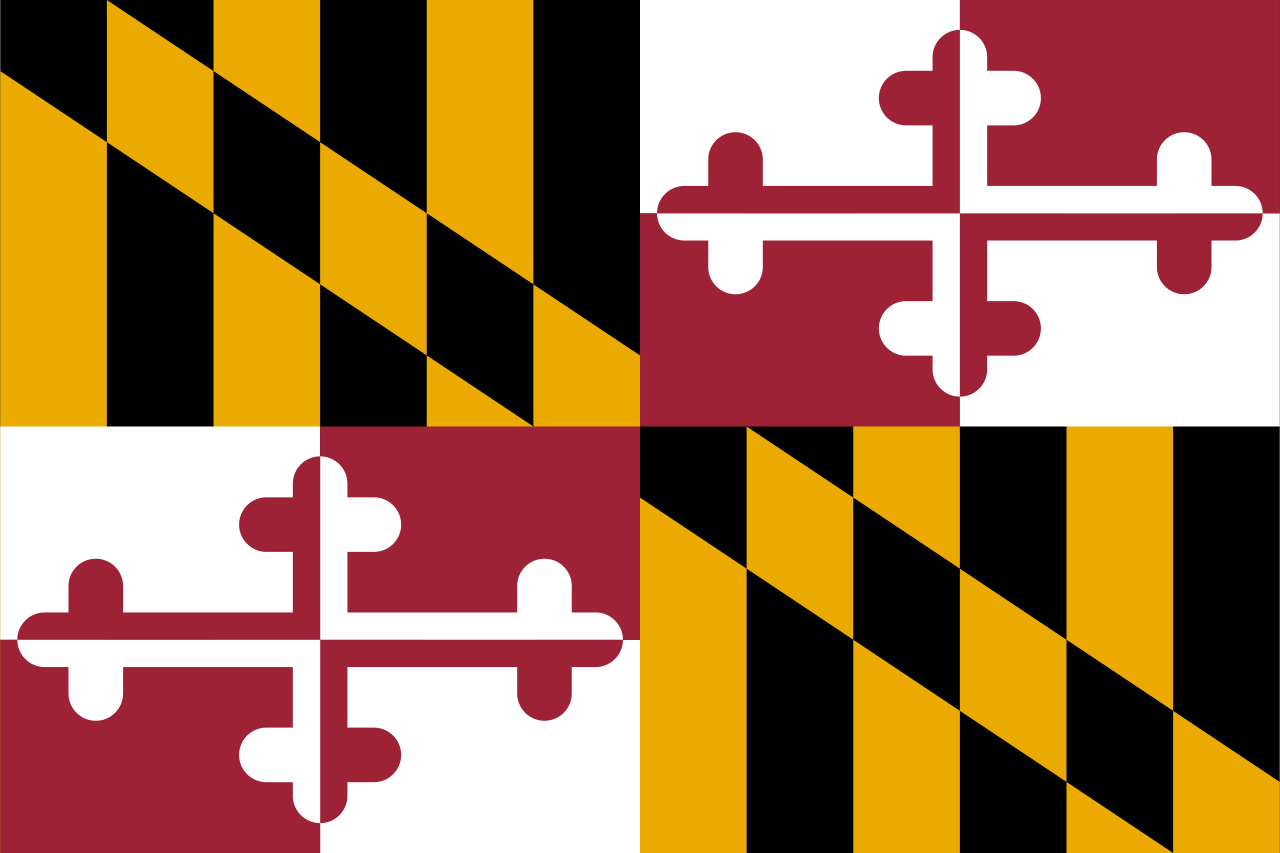
The Maryland flag is a bold heraldic pattern of black and gold bands alternating with red and white crosses. It is the banner of arms of the Barons Baltimore, a U.S. state flag based on a family coat of arms that combines the arms of the Calvert and Crossland families.
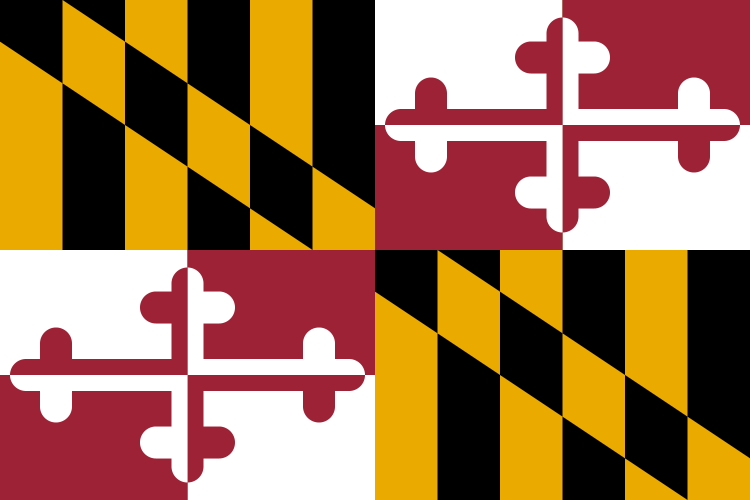
What the Maryland state flag looks like
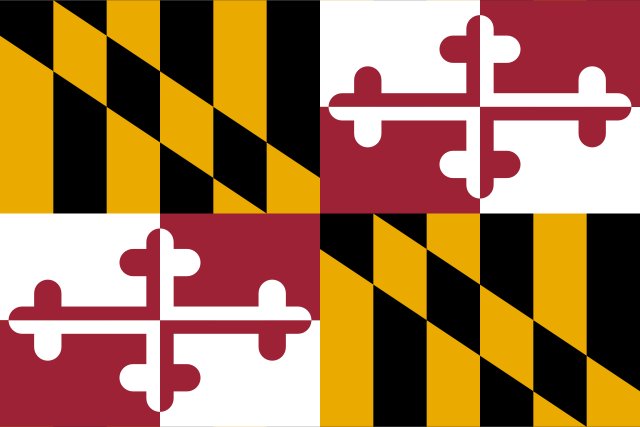
The Maryland state flag is divided into four quarters. The first and fourth quarters, at the upper hoist and lower fly, show the arms of the Calvert family: vertical bands alternating gold and black, crossed by a diagonal band in reversed colors. The second and third quarters, at the upper fly and lower hoist, show the arms of the Crossland family: a red and white cross bottony, a cross whose arms end in three-lobed, clover-like tips, set in reversed colors on a quartered red and white field.
The result is a busy, colorful flag with no seal, lettering or stars. It is often named one of the most distinctive flags in the country. Four colors appear in the design: black, gold, red and white.
Maryland flag meaning and symbolism
The flag is a family emblem rather than a collection of symbols. The gold and black pattern belongs to George Calvert, 1st Baron Baltimore, and to his son Cecil Calvert, who as the 2nd Lord Baltimore received the charter for the colony of Maryland in 1632 and sent the first settlers in 1634. The red and white cross comes from the arms of the Crossland family, the family of George Calvert's mother, Alicia Crossland. Together they form the arms of Lord Baltimore, who owned the colony.
The flag has no official explanation for its colors, which come from the heraldic blazons of the two families. The state's motto, Fatti maschi, parole femmine, usually translated as "Manly deeds, womanly words," is on the state seal but not on the flag.
History of the Maryland flag
Maryland was founded as a proprietary colony of the Calvert family, and during the colonial period only the gold and black Calvert arms were associated with Maryland. The state stopped using those colors after American independence, and they were reintroduced in 1854. In the Civil War, Union troops from Maryland favored the yellow-and-black Calvert arms, while Confederate units became associated with the Crossland banner and its bottony cross. When the present flag first appeared in 1876 it included both, which may have been a last-minute compromise or, as the Maryland Secretary of State suggests, a representation of the reunion of the state's citizens.
A flag with this design was first flown in 1876 from the Maryland building at the Centennial Exposition, and it was flown again at events such as a Baltimore parade in 1880. The Maryland General Assembly officially adopted it as the state flag in 1904.
In a 2001 survey by the North American Vexillological Association, Maryland's flag placed fourth in design quality out of 72 flags of Canadian provinces, U.S. states and territories. To see other state designs, visit our U.S. state flags page or the flag of the United States.
Interesting facts about the Maryland flag
- Maryland's flag is the banner of arms of Cecil Calvert, 2nd Baron Baltimore, and the only permitted ornament on top of a flagstaff carrying it is a gold cross bottony.
- The flag uses no letters, seals or stars, which makes it easy to recognize.
- The state motto, Fatti maschi, parole femmine, is in Italian and appears on the state seal, not on the flag.
Maryland flag colors
#FFFFFFRGB
255, 255, 255CMYK
0, 0, 0, 0#9D2235RGB
157, 34, 53CMYK
0, 78, 66, 38#000000RGB
0, 0, 0CMYK
0, 0, 0, 100#EAAA00RGB
234, 170, 0CMYK
0, 27, 100, 8Maryland flag facts
| Adopted | November 25, 1904 |
|---|---|
| Proportions | 2:3 |
| Symbols | Crossland banner, escutcheon |
| State capital | Annapolis |
| State motto | Fatti maschi, parole femmine |
| Population | 6,177,224 |
Maryland state flag FAQ
Why is Maryland's flag so different?
It is based on the heraldic coats of arms of two families, the Calverts and the Crosslands, rather than on a state seal on a solid color, which is the pattern used by many other states.
What colors are on the Maryland flag?
The flag uses black, gold, red and white.
When was the Maryland flag adopted?
The General Assembly adopted it as the official state flag in 1904. The design had been flown since 1876.
What does the Maryland flag represent?
It represents the heritage of the colony's founders, the Calvert family, and their Crossland relatives. The Maryland Secretary of State suggests the combination of the two patterns represents the reunion of the state's citizens after the Civil War.
How is the Maryland flag ranked among state flags?
In a 2001 North American Vexillological Association survey it placed fourth in design quality out of 72 flags of Canadian provinces, U.S. states and territories, behind New Mexico, Texas and Quebec.
Why does Maryland have a checkered flag?
The pattern comes from heraldry, not decoration. The gold and black bars belong to the Calvert family arms, whose bars symbolize a palisade, and the red and white quarters with a cross belong to the Crossland arms. Together they form the banner of arms of Lord Baltimore.
Did Maryland change its flag?
Not since the current design was adopted. The flag first flew in 1876 and became official in 1904. Before that, Maryland was usually represented by unofficial banners, most often the state seal on a blue background, and the Calvert colors were reintroduced in 1854.
What are the Maryland Terps' colors?
The University of Maryland teams use the four colors of the state flag. Red and white are the primary colors, with black and gold as accents, and the flag is displayed on the shoulder of the football uniforms. These are also the md flag colors.