U.S. state · HI
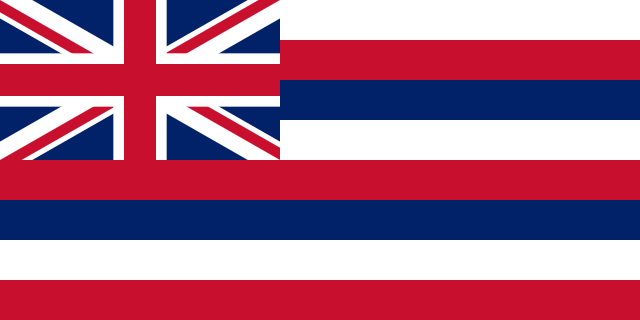
Flag of Hawaii
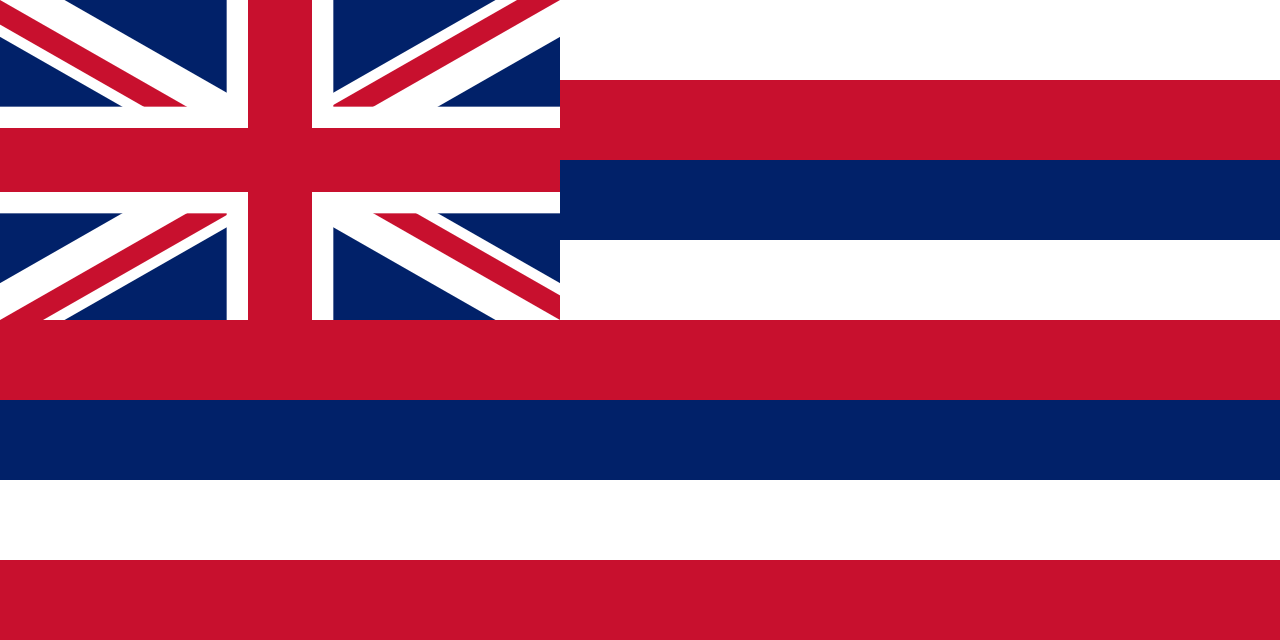
The Hawaii flag has eight horizontal stripes of white, red and blue with the British Union Jack in the upper corner. It carries the Union Jack of the United Kingdom, and it dates back to the Kingdom of Hawaii.
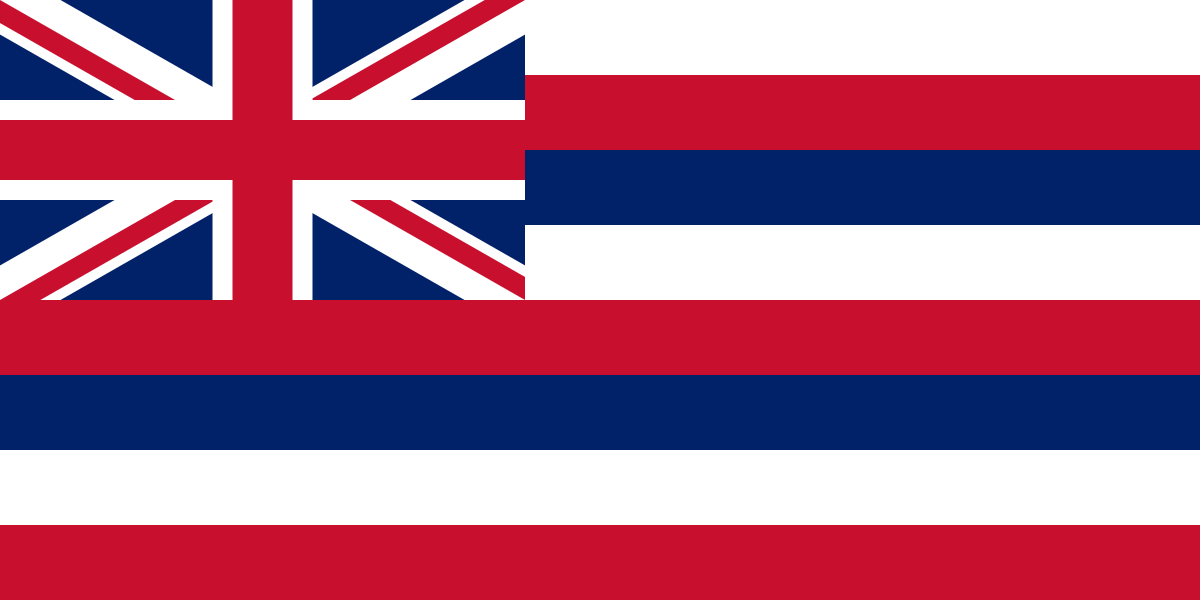
What the Hawaii state flag looks like
The state flag of Hawaii is a rectangle in a 1:2 ratio. Its field is made of eight horizontal stripes that repeat in the order white, red, blue. Counting from the top, the stripes run white, red, blue, white, red, blue, white, red, so the bottom stripe is red. In the upper hoist corner sits a canton showing the Union Jack, the flag of the United Kingdom, with the red cross of St. George, the white diagonal cross of St. Andrew and the red diagonal cross of St. Patrick on a blue ground.
There is no coat of arms, seal or lettering on the flag. The stripes and the canton are all it uses. Unlike most state flags, it is not a seal on a blue field, so it is easy to tell apart from the others at a glance.
Hawaii flag meaning and symbolism
The eight stripes are usually said to stand for the eight main islands of the archipelago: Hawaiʻi, Maui, Kahoʻolawe, Lānaʻi, Molokaʻi, Oʻahu, Kauaʻi and Niʻihau. The colors red, white and blue are not explicitly defined in the state statute.
The Union Jack is the part that surprises most visitors. Hawaii was never formally part of the British Empire. The canton is a legacy of the British Royal Navy's historical relations with the Kingdom of Hawaii and of the pro-British sentiment of its first ruler, Kamehameha I. An unverified anecdote says that during the War of 1812 Kamehameha, to avoid offending either side, designed a flag that combined elements of the British and American flags. The flag is better read as a record of those relations than as a sign of British rule.
For many Hawaiians the flag also represents the Hawaiian Kingdom and its independence. Some sovereignty activists fly it upside down as a signal of distress, a practice that echoes the traditional use of an inverted flag at sea.
History of the Hawaii flag
The earliest versions of a Hawaiian flag date to the reign of Kamehameha I, who unified the islands by 1810. In 1817 the ship Kaʻahumanu became the first Hawaiian vessel to sail to a foreign port under a distinct Hawaiian flag, and an 1818 visitor described a flag of seven stripes with the Union Jack in the corner. Until 1845, visitors reported various versions of the flag with different numbers of stripes and colors.
The design was specified with eight stripes after the Paulet Affair of 1843, a five-month unofficial occupation of the islands by a British naval officer, and the new flag was officially unfurled on May 25, 1845. It is the design still used today. The kingdom's sovereignty was restored on July 31, 1843, a date that Governor John Waiheʻe proclaimed in 1990 as Lā Hae Hawaiʻi, or Hawaiian Flag Day. The motto on the state seal, Ua Mau ke Ea o ka ʻĀina i ka Pono, which means "The life of the land is perpetuated in righteousness," comes from that restoration.
After the overthrow of the monarchy in 1893, the Republic of Hawaii kept the same flag in 1894. The U.S. annexed the islands in 1898, and the flag continued as the flag of the Territory of Hawaii. When Hawaii became the 50th state in 1959, the design stayed in use as the official state flag. A separate sovereignty flag, sometimes called the Kanaka Maoli flag, is flown by some Hawaiians as a political emblem and is not an official symbol.
Flag etiquette in Hawaii
The Hawaii flag is flown with the U.S. flag at government buildings and schools, and the U.S. flag takes the place of honor. When the governor orders flags lowered to half-staff after the death of a public figure or in remembrance of an event, the state flag is lowered along with the national flag. Learn more about how the states compare on our list of U.S. state flags, or see the national flag on the page for the United States.
Hawaii flag colors
#C8102ERGB
200, 16, 46CMYK
0, 92, 77, 22#FFFFFFRGB
255, 255, 255CMYK
0, 0, 0, 0#012169RGB
1, 33, 105CMYK
99, 69, 0, 59Hawaii flag facts
| Adopted | May 25, 1845 |
|---|---|
| Proportions | 1:2 |
| Symbols | Union Jack |
| State capital | Honolulu |
| State motto | Ua Mau ke Ea o ka 'Āina i ka Pono |
| Population | 1,455,271 |
Hawaii state flag FAQ
Why is the UK flag in the Hawaii flag?
The Union Jack is a legacy of the British Royal Navy's relations with the Kingdom of Hawaii and of the pro-British sentiment of Kamehameha I. Hawaii was never formally part of the British Empire.
What do the eight stripes on the Hawaii flag mean?
The stripes are generally said to represent the eight main islands of Hawaii: Hawaiʻi, Maui, Kahoʻolawe, Lānaʻi, Molokaʻi, Oʻahu, Kauaʻi and Niʻihau.
Was Hawaii originally British?
No. Hawaii was an independent kingdom. A British naval officer occupied the islands unofficially for about five months in 1843, during the Paulet Affair, and the kingdom's sovereignty was restored that same year.
What is the actual Hawaiian flag?
The official flag of the State of Hawaii has eight white, red and blue stripes with the Union Jack in the canton. Its basic design goes back to the Kingdom of Hawaii and has been in use since 1845.
Why are there two different Hawaiian flags?
The official state flag has eight stripes and the Union Jack and has been in use since 1845. The other is the Kānaka Maoli flag, with nine green, red and yellow stripes, introduced in 2001. Claims that it was the kingdom's original flag are unverified and widely disputed.
What is the original Hawaiian flag?
Early flags varied. A British flag was raised in 1794, a distinct Hawaiian flag first sailed abroad in 1817, and visitors reported different numbers of stripes until the eight-stripe design was unfurled on May 25, 1845. That design is still the state flag today.