Africa · UG / UGA
Flag of Uganda
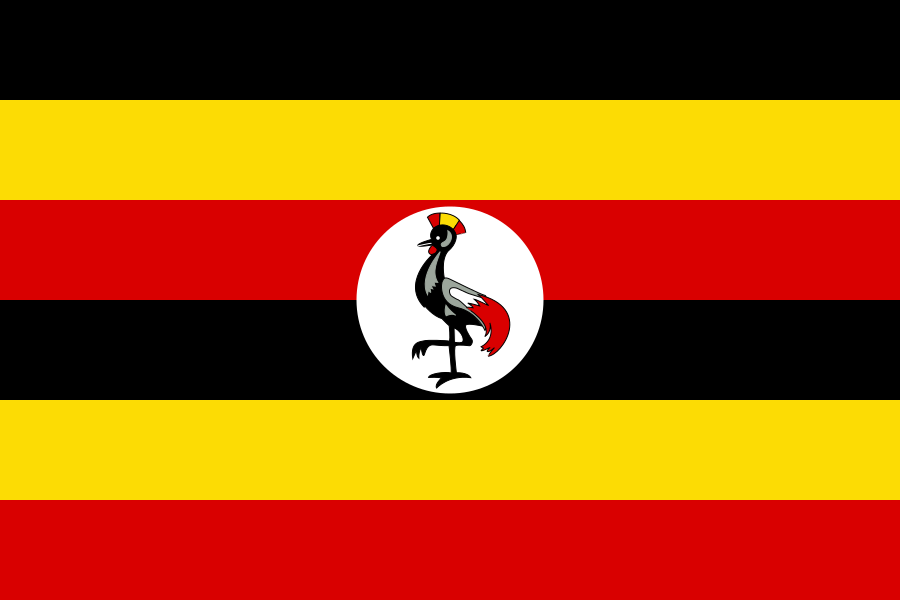
The Uganda flag has six horizontal stripes in black, yellow and red, repeated twice, with a white disc in the center holding a grey crowned crane. It was adopted when Uganda became independent on 9 October 1962.
What the flag of Uganda looks like
The flag of Uganda has six horizontal stripes of equal height. From the top, the colors are black, yellow, red, black, yellow and red. In the center is a white disc that holds a grey crowned crane. The bird stands in profile, facing the hoist (the left side), with one leg raised. The proportions are 2:3.
The bird is the main feature, and people sometimes mistake it for a chicken or a rooster, but it is a grey crowned crane, a tall African bird with a crest of golden feathers on its head. On the flag it is shown in a simplified way. You can also see the design as the Uganda flag emoji.
Uganda flag colors
Color codes measured from the official design. Use HEX for the web and CMYK for print.
HEX
#FCDC04RGB
252, 220, 4CMYK
0, 13, 98, 1HEX
#000000RGB
0, 0, 0CMYK
0, 0, 0, 100HEX
#D90000RGB
217, 0, 0CMYK
0, 100, 100, 15HEX
#FFFFFFRGB
255, 255, 255CMYK
0, 0, 0, 0Uganda flag meaning and symbolism
The colors are said to have the following meanings:
- Black stands for the people of Uganda.
- Yellow stands for sunshine.
- Red stands for brotherhood.
The grey crowned crane is Uganda's national bird. Among the Baganda people it is a symbol of good fortune, longevity and wealth. It was also the main feature of the badge of the British Protectorate of Uganda, chosen partly because the British did not want to use symbols tied to one region.
History of the Uganda flag
Uganda was a British protectorate from the 1890s. From 1914 to 1962 it flew the British Blue Ensign with a colonial badge showing a crested crane. A provisional green, blue and yellow flag proposed in March 1962 was dropped, and the black, yellow and red flag with the crane was adopted at independence.
The new flag was raised on 9 October 1962 and has been used ever since, through the periods of Idi Amin and later governments. The country's name comes from the Buganda kingdom, the largest of its traditional kingdoms.
Uganda flag facts
| Country | Uganda |
|---|---|
| Flag adopted | October 9, 1962 |
| Proportions | 2:3 |
| Colors | #FCDC04, #000000, #D90000, #FFFFFF |
| Symbols | Grey Crowned Crane, roundel |
| Flag emoji | 🇺🇬 |
| Country code | UG, UGA (ISO 3166) |
| Capital | Kampala |
| Continent | Africa |
| Population | 47,123,531 |
| Area | 241,038 km² |
| Currency | Ugandan shilling |
| National anthem | Oh Uganda, Land of Beauty |
Uganda flag: frequently asked questions
Why does Uganda have a chicken on its flag?
It is not a chicken. The bird is a grey crowned crane, the national bird of Uganda, which has a crest of golden feathers and was used on the colonial badge.
What is the meaning of Uganda's flag?
Black stands for the people of Uganda, yellow for sunshine and red for brotherhood. The crane, the national bird, is a symbol of good fortune, longevity and wealth among the Baganda.
What was Uganda called before?
Before independence in 1962 it was the Uganda Protectorate of the British Empire. The name Uganda comes from the Buganda kingdom.
Which flag was replaced by the Uganda flag?
The British Blue Ensign with the Uganda colonial badge, showing a crane, was replaced by the national flag at independence on 9 October 1962.
Where is 🇺🇬?
The flag emoji 🇺🇬 stands for Uganda, a landlocked country in East Africa whose capital is Kampala.
What is the real flag of Uganda?
The flag adopted on 9 October 1962 has six equal horizontal bands of black, yellow, red, black, yellow and red, with a white disc and a crested crane in the center. A green, blue and green provisional design with a yellow crane was proposed in March 1962 but never used.
Who designed the flag of Uganda?
The designer is disputed. Grace Ibingira, who chaired the cabinet subcommittee that chose the design, is often cited, but other people have claimed credit. In 2007 a retired teacher said he had submitted the design in 1961. The flag was adopted at independence on 9 October 1962.