Africa · ZA / ZAF
Flag of South Africa
The South Africa flag has six colors: red and blue stripes, a green horizontal Y-shaped band with white edges, and a black triangle with a gold border. Adopted on 27 April 1994, it was designed to show a country coming together.
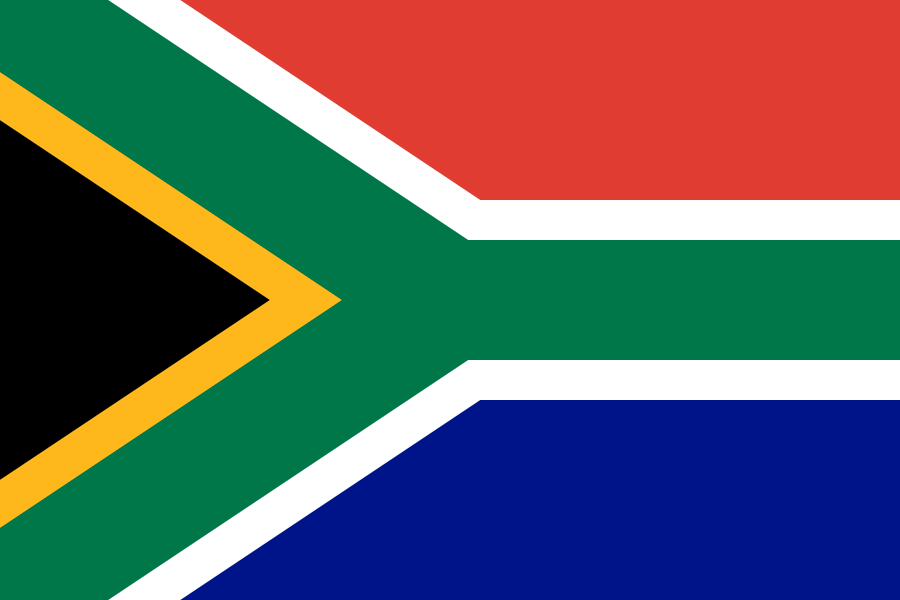
What the flag of South Africa looks like
The flag of South Africa is made of a horizontal Y shape, or pall, that opens toward the hoist and then runs as a single band to the fly. The upper part of the field is red, the lower part is blue, and the Y itself is green with a thin white border on each side. At the hoist, a black triangle is edged with a narrow gold (yellow) band. The ratio is 2:3.
The flag is unusual in several ways. It does not have a coat of arms or any symbol such as a star or cross, and when it was adopted it was the only national flag in the world with six colors in its main design and no seal or other emblem. The shape of the Y is also rare among flags.
You can see a small version on the South Africa flag emoji page, or use the download page for image files.
South Africa flag colors
Color codes measured from the official design. Use HEX for the web and CMYK for print.
HEX
#007749RGB
0, 119, 73CMYK
100, 0, 39, 53HEX
#E03C31RGB
224, 60, 49CMYK
0, 73, 78, 12HEX
#001489RGB
0, 20, 137CMYK
100, 85, 0, 46HEX
#FFFFFFRGB
255, 255, 255CMYK
0, 0, 0, 0HEX
#000000RGB
0, 0, 0CMYK
0, 0, 0, 100HEX
#FFB81CRGB
255, 184, 28CMYK
0, 28, 89, 0South African flag meaning and symbolism
According to official South African government information, the flag is a summary of the main elements of the country's flag history, and no universal symbolism should be attached to any of the colors. What the flag as a whole was meant to show is the coming together of the different groups in South Africa. The Y shape is the strongest symbol: two streams join into one road that goes forward, and this is often described as the convergence of diverse elements in society, then moving ahead in unity.
Many people still give each color a personal meaning, and explanations appear in the media from time to time. The gold is commonly said to stand for the country's mineral wealth. Such readings are unofficial, and different sources give different ones.
The colors also have a historical background. Black, green and gold are the colors of the African National Congress (ANC). Red, white and blue are found in the flags of the Netherlands and the United Kingdom, and the colors of the Boer republics' Vierkleur and of the old South African flag are also reflected. Putting these together was one way of giving every part of the population a place in the flag.
History of the South African flag
From 1928 until 1994, South Africa used a flag with three horizontal stripes of orange, white and blue, based on the old Dutch flag. In the center of the white stripe there were three small flags: the British Union Flag, and the flags of the Orange Free State and the Transvaal. The flag was widely used under the apartheid system, and for many black South Africans it became a symbol of that system.
When apartheid was ending, the country needed a new flag. A public competition in 1993 drew more than 7,000 designs, but none won enthusiastic support. In the end, a final design derived from one by the State Herald, Frederick Brownell, was adopted in March 1994. It was approved for temporary use, and it was first flown on 27 April 1994, the day of the first democratic elections. It was meant to be an interim flag, but the Constitutional Assembly decided in 1995 to keep it, and it became part of the constitution, which came into force in 1997.
There have been legal questions over the old flag since then. In 2019 a South African court ruled that the gratuitous display of the old flag is hate speech and a form of unfair discrimination, though it can be shown for artistic, academic or journalistic reasons.
South Africa flag facts
| Country | Republic of South Africa |
|---|---|
| Flag adopted | April 27, 1994 |
| Proportions | 2:3 |
| Colors | #007749, #E03C31, #001489, #FFFFFF, #000000, #FFB81C |
| Symbols | triangle |
| Flag emoji | 🇿🇦 |
| Country code | ZA, ZAF (ISO 3166) |
| Capital | Pretoria, Cape Town |
| Continent | Africa |
| Population | 62,027,503 |
| Area | 1,221,037 km² |
| Currency | rand |
| National anthem | national anthem of Mzansi |
South Africa flag: frequently asked questions
What do the colors of the South African flag mean?
The colors have no official individual meaning. Some people give them personal readings, and the gold is commonly linked to mineral wealth. The Y shape stands for unity and moving forward together.
Why did South Africa change its flag?
The old flag was linked to colonial rule and the apartheid system. A new flag was needed for the first democratic elections in 1994, and the current flag was introduced for that.
Who designed the South African flag?
Frederick Brownell, the State Herald at the time, designed it. It was first raised on 27 April 1994.
What are some interesting facts about the South African flag?
When adopted in 1994 it was the only national flag with six colors in its main design and no seal. Its ratio at the fly end is 5:1:3:1:5, and designer Frederick Brownell said the green Y was inspired by Anglican priests' chasubles. It is nicknamed the Seskleur ("six color").
What was the South African flag before 1994?
The 1928 to 1994 flag was based on the Dutch Prince's Flag (Prinsenvlag in Afrikaans), with orange, white and blue horizontal stripes. Small flags in the center showed the British Union Flag and the flags of the Orange Free State and the Transvaal.
What flag is 🇿🇦?
The 🇿🇦 emoji is the flag of South Africa, with its green Y, black triangle, and red and blue bands. It is made from the regional indicator letters Z and A, the country's two-letter code. Windows shows the letters ZA instead of the flag.