Asia · IR / IRN
Flag of Iran
The Iran flag is a horizontal tricolor of green, white and red with a red emblem in the center and the words Allahu Akbar repeated along the edges of the green and red bands. The green-white-red colors date back to the early 20th century.
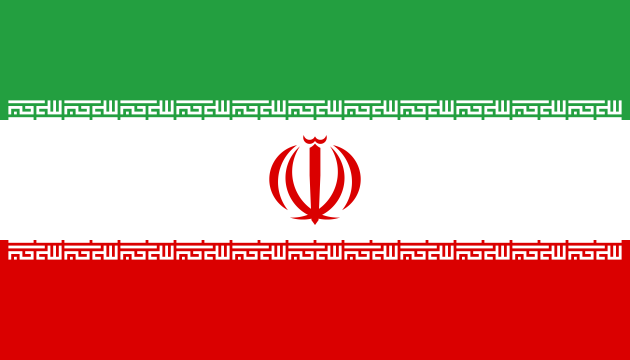
What the flag of Iran looks like
The flag of Iran has three horizontal bands of equal height: green at the top, white in the middle and red at the bottom. The proportions are 4:7. A red emblem is placed in the center of the white band. On the edge between the green and white bands, and between the white and red bands, the phrase Allahu Akbar ("God is great") is written in white Kufic script, 11 times on each edge, so 22 times in total.
The emblem is a stylized form of the word Allah. It is made of four crescents and a central vertical stroke (read as a sword), and the shape can also be seen as a tulip. The design is credited to Hamid Nadimi, and the flag has been in its present form since 29 July 1980, the date usually given for its official adoption.
You can see the same three colors in the Iran flag emoji, though at small sizes the emblem is simplified. High-resolution files are available on the Iran flag download page.
Iran flag colors
Color codes measured from the official design. Use HEX for the web and CMYK for print.
HEX
#FFFFFFRGB
255, 255, 255CMYK
0, 0, 0, 0HEX
#DA0000RGB
218, 0, 0CMYK
0, 100, 100, 15HEX
#239F40RGB
35, 159, 64CMYK
78, 0, 60, 38Iran flag meaning and symbolism
The three colors are traditionally explained as green for growth, happiness and Islam, white for peace and red for courage and martyrdom. Other interpretations connect the colors with Persian poetry and with the land of Iran. These are popular readings, not official definitions: the law describes the design of the flag in detail but does not give an exact meaning for each color.
The 22 repetitions of Allahu Akbar refer to the date of the victory of the Islamic Revolution in 1979, which was 22 Bahman in the Iranian calendar (11 February). The emblem is understood by the government to represent the word Allah, and also the unity of God, and its four crescents and sword are said to reflect the main principles of Islam. Because of the emblem and the phrase, the flag is used as a symbol of the Islamic Republic.
History of the Iran flag
Persian banners go back thousands of years. Ancient and medieval dynasties used a range of standards: the best-known is the Derafsh Kaviani, a legendary banner linked to the Shahnameh and to the Sasanian empire, and later Safavid and Qajar rulers flew flags with a lion and a sun. Iran used a lion-and-sun emblem for centuries as one of its main symbols, and in the 19th century it appeared on flags in various forms.
The green-white-red tricolor was introduced in 1905 during the Persian Constitutional Revolution, and the Supplementary Fundamental Laws of 1907 described it with a lion and sun emblem in the middle. The lion and sun, with the lion holding a sword in front of a rising sun and sometimes a crown above, stayed in use under the Pahlavi dynasty, and the old state and national flags remained unchanged until July 1980. After the monarchy was overthrown, the new republic replaced the lion and sun with the present emblem. The change was made in stages, and the final design was formally adopted in 1980.
The same lion-and-sun flag, without the crown in most cases, stayed alive among Iranians living outside the country.
Why are there two Iranian flags?
The two flags people refer to are the official flag of the Islamic Republic, with the Allah emblem, and the older flag with the lion and sun. Both use the same green, white and red stripes. The older flag is often called the flag of pre-revolution Iran and is used by many supporters of the former monarchy and by other opponents of the Islamic Republic. Which of the two is "correct" depends on the point of view: only the flag with the Islamic Republic emblem is the legal flag of Iran today.
Because Iran sits at the edge of Central Asia and the Middle East, it is also compared with other flags of Asia. The flags of Tajikistan and Kurdistan share the same colors, and the flag of Afghanistan did in the past.
Iran flag facts
| Country | Iran |
|---|---|
| Flag adopted | July 29, 1980 |
| Proportions | 4:7 |
| Colors | #FFFFFF, #DA0000, #239F40 |
| Symbols | Emblem of Iran |
| Flag emoji | 🇮🇷 |
| Country code | IR, IRN (ISO 3166) |
| Capital | Tehran |
| Continent | Asia |
| Population | 92,417,700 |
| Area | 1,648,195 km² |
| Currency | Iranian rial |
| National anthem | National Anthem of the Islamic Republic of Iran |
Iran flag: frequently asked questions
Why does Iran have two flags?
The official flag is the green, white and red tricolor with the emblem of the Islamic Republic, adopted in 1980. The earlier flag, used until 1980, had a lion and sun in the center. Both use the same three colors.
Why did they change the Iranian flag?
After the 1979 revolution the monarchy was replaced by an Islamic Republic. The lion and sun, linked to the monarchy, was removed and a new emblem with the word Allah was approved in 1980. The three colors were kept.
What does the lion on the Iran flag mean?
The lion and sun was an old Persian symbol that became the recognized emblem of Iran by the time of Shah Abbas in the Safavid era. It appeared on flags through the Qajar and Pahlavi periods, as a lion holding a sword in front of a sun. It is not on the current official flag, which has the Islamic emblem.
What does the writing on the Iranian flag say?
The phrase Allahu Akbar, meaning God is great, is repeated 22 times in Kufic script along the border of the green and red stripes, 11 times on each side. The number refers to 22 Bahman, the day of the 1979 revolution's victory.
What was the flag of Iran before 1979?
Before the 1979 revolution Iran used the same green, white and red tricolor with a lion and sun emblem in the middle. The tricolor was first adopted in the 1905 constitution, and the lion and sun was described in 1907. The Pahlavi-era flag was modified in 1933 and 1964, and the current flag replaced the old one in July 1980.
Flags of neighboring countries
 United Arab Emirates
  Afghanistan
  Armenia
  Azerbaijan
  Bahrain
  Iraq
Iraq  Kuwait
  Oman
Oman  Pakistan
  Qatar
Qatar  Saudi Arabia
  Turkmenistan
  Turkey