U.S. state · VA
Flag of Virginia
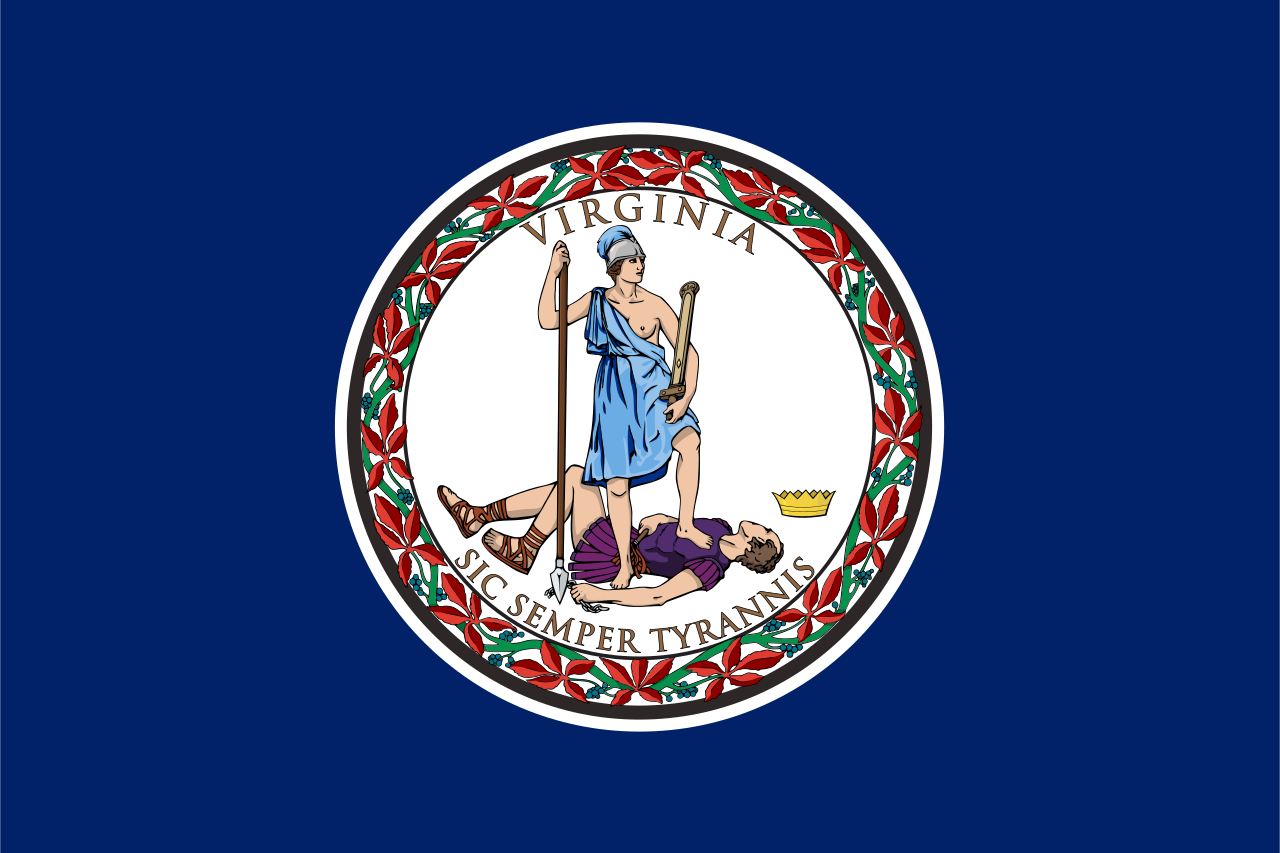
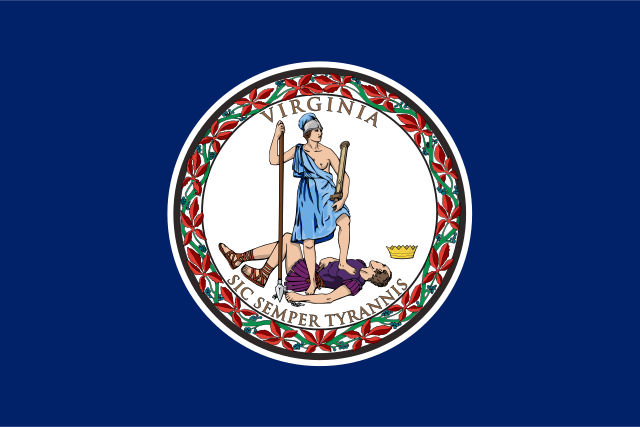
The Virginia flag is a deep blue field with a white circle in the center. Inside it, the warrior woman Virtus stands over a fallen figure of Tyranny, above the motto "Sic Semper Tyrannis".
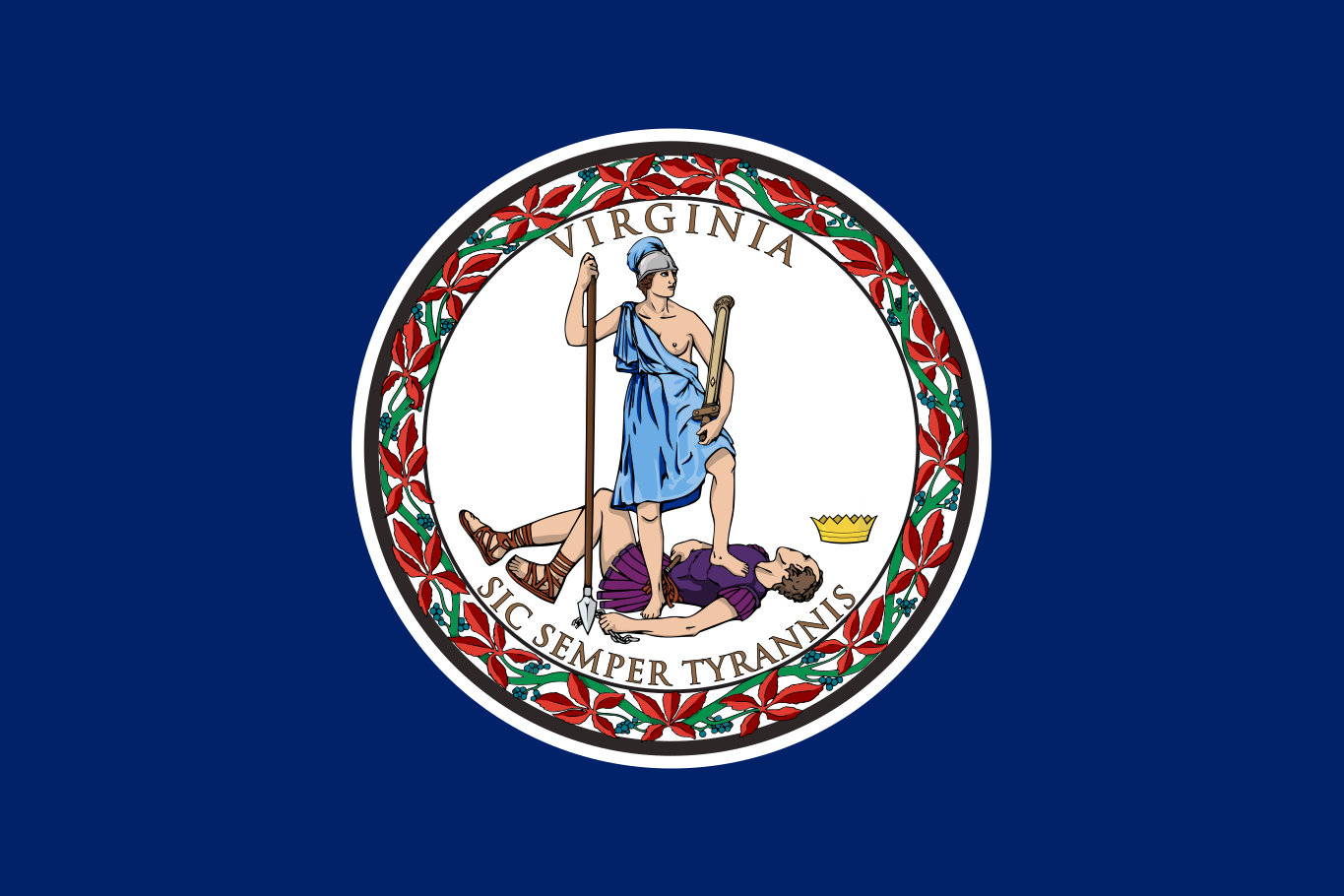
What the Virginia flag looks like
The Virginia state flag is a dark blue rectangle with a white circle at the center. The circle holds the obverse of the Great Seal of the Commonwealth. A woman dressed as an Amazon, with one breast bare in the manner of classical depictions, rests a spear in her right hand with the point touching the ground and holds a sheathed sword in her left. Her left foot rests on the body of a man lying face up, who has a broken chain in one hand and a whip in the other, with a fallen crown nearby.
The Latin words Sic Semper Tyrannis are written below the figures, and the word Virginia appears above them. The flag is usually seen with white fringe on the edges, and its proportions are 3:2.
Virginia flag meaning and symbolism
The woman is Virtus, the Roman personification of virtue. The man beneath her stands for tyranny, and the broken chain and the crown at his side show that he has been overthrown. Together they present the state as a defender of liberty against despotism.
The motto Sic Semper Tyrannis means "thus always to tyrants". The seal imagery dates from 1776, at the time of the American Revolution, and the fallen figure symbolizes the defeat of British rule. The imagery is why many people ask who the woman on the flag is.
History of the Virginia flag
The Great Seal was prepared in 1776 by a committee of four (Richard Henry Lee, George Mason, George Wythe and Robert Carter Nicholas Sr.), and the design is generally believed to be principally the work of Wythe. The blue flag with the seal was officially adopted on April 30, 1861, shortly after Virginia seceded from the Union. It faded from official use after the Civil War.
The current flag was adopted on March 28, 1912, designed to be similar to the 1861 flag. When the state seal was standardized in February 1950, the flag was updated to match. Virginia was known as the Colony and Dominion of Virginia before 1776, and it still uses the nickname Old Dominion. To see its place among other states, visit the U.S. state flags page, or compare with West Virginia, which separated from it in 1863.
Virginia flag colors
#012168RGB
1, 33, 104CMYK
99, 68, 0, 59#FFFFFFRGB
255, 255, 255CMYK
0, 0, 0, 0Virginia flag facts
| Adopted | April 30, 1861 |
|---|---|
| Proportions | 2:3 |
| Symbols | seal of Virginia |
| State capital | Richmond |
| State motto | Sic semper tyrannis |
| Population | 8,631,393 |
Virginia state flag FAQ
Who is the woman on the Virginia flag?
She is Virtus, the Roman personification of virtue. She is shown with a spear and a sheathed sword, standing over the figure of Tyranny.
What does Sic Semper Tyrannis mean?
It is Latin for "thus always to tyrants". It is the Virginia state motto and appears on both the state seal and the flag.
What is the meaning behind the Virginia flag?
The flag shows virtue triumphing over tyranny. Virtus has defeated Tyranny, whose crown has fallen and whose chain is broken. It is a symbol of liberty from the era of the American Revolution.
Did Virginia change its flag?
The basic design dates from 1861. The flag was readopted in 1912 and standardized by the General Assembly in February 1950, but the state has not adopted a different flag.
What is special about Virginia's state flag?
It is the only U.S. state flag that depicts nudity, since Virtus is shown with a bare breast in the manner of classical Amazons. It is also one of six state flags with a woman, along with Florida, New York, New Jersey, Wyoming and Idaho. In a 2001 vexillology survey of 72 flags it ranked 54th.