U.S. state · VT
Flag of Vermont
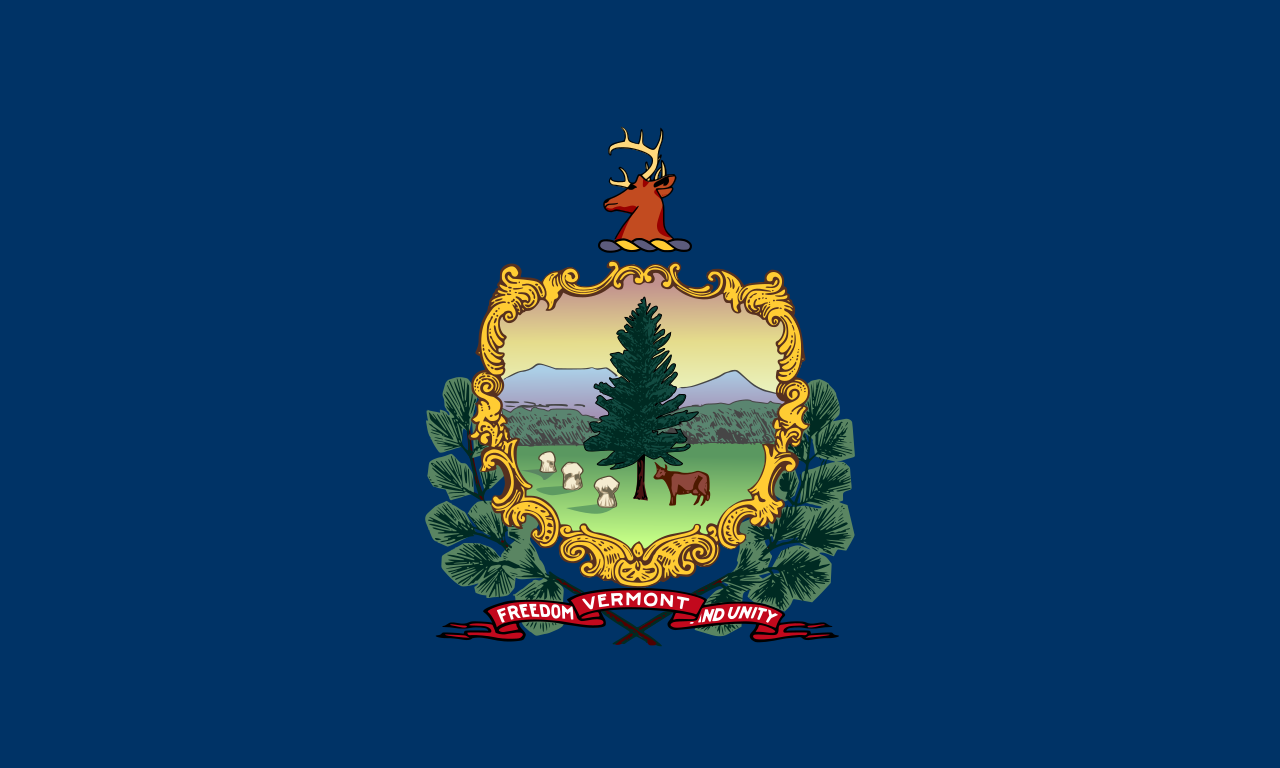
The Vermont flag is a deep blue field with the state coat of arms in the center. It shows a pine tree, a cow, wheat sheaves and mountains, with a buck's head on top and the motto "Freedom and Unity".
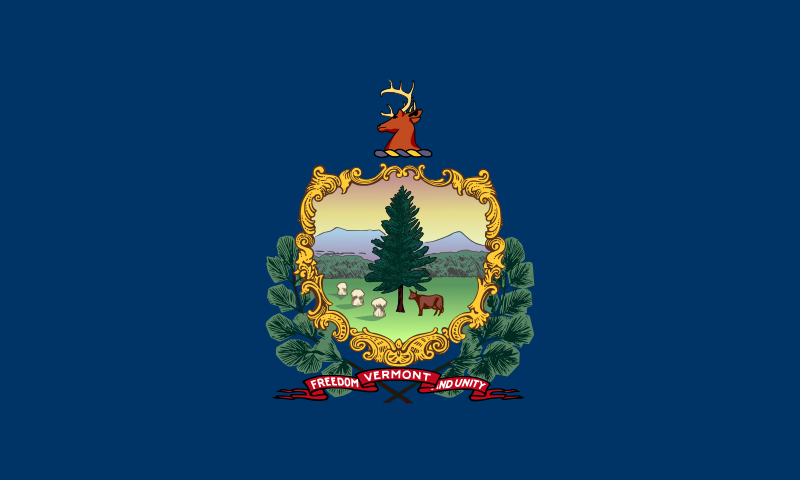
What the Vermont flag looks like
The state flag of Vermont is a solid blue rectangle with the coat of arms in the middle. The shield contains a large pine tree in front of a landscape, with a red cow and three sheaves of wheat beside it, and blue mountains in the background. Two pine branches are crossed between the shield and the scroll, and the head of a buck (a male deer) rests on top.
A scroll under the shield carries the name Vermont and the state motto, Freedom and Unity. The colors are blue, green, red and gold, and the flag is shown in 5:3 proportions.
Vermont flag meaning and symbolism
The shield presents the main parts of the state's early life. The pine tree stands for the forests, the cow and the three sheaves of wheat for the dairy and farming industries. The Green Mountains in the background give the state its name, Vermont coming from the French words for green mountain. The pine branches are a New England emblem recalling the small pine sprigs worn at the Battle of Plattsburgh in the War of 1812, and the deer's head stands for the wildlife of the state.
The motto Freedom and Unity balances the freedom of the individual citizen with the welfare of the common good. To compare it with other designs, see all U.S. state flags.
History of the Vermont flag
Vermont declared itself an independent republic in 1777 and joined the United States in 1791 as the fourteenth state. The design of the coat of arms is credited to Ira Allen and dates to 1778.
Vermont's earlier state flags, adopted in 1804 and 1837, were based on the striped U.S. flag. The 1837 version had a single large star around the coat of arms in the canton. Because of confusion between this flag and the U.S. flag, the design of the governor's flag, which had long been used by Vermont troops, was adopted as the state flag on June 1, 1923. It puts the arms on a plain blue background and has remained unchanged since.
See also the flag of the United States, which the earlier Vermont flags resembled.
Vermont flag colors
#003366RGB
0, 51, 102CMYK
100, 50, 0, 60Vermont flag facts
| Adopted | June 1, 1923 |
|---|---|
| Proportions | 3:5 |
| State capital | Montpelier |
| State motto | Freedom and Unity |
| Population | 643,077 |
Vermont state flag FAQ
Why did Vermont change its flag?
The earlier flag, with the coat of arms in a striped field, looked too much like the American flag. In 1923 the state replaced it with the arms on a plain blue background.
What tree is on the Vermont flag?
A pine tree stands at the center of the coat of arms. Pine branches are also crossed beneath the shield.
What is the Vermont state motto?
The state motto is Freedom and Unity. It appears on a scroll at the bottom of the coat of arms.
What happened to the Vermont Republic?
Vermont was an independent republic from 1777 until 1791, when it joined the United States as the fourteenth state.
What does the Vermont flag mean?
The coat of arms shows the state's resources: the pine tree stands for its forests, the cow and three wheat sheaves for dairy and farming, and the mountains for the Green Mountains. The buck's head stands for wildlife, and the motto Freedom and Unity balances individual liberty with the common good.
What colors are on the Vermont flag?
The field is solid blue. The coat of arms adds green for the landscape, blue mountains, a yellow sky and wheat sheaves, a red cow, and a natural-colored pine tree and buck's head. So the flag shows blue, green, red and yellow-gold.
What did the old Vermont flag look like?
Before 1923 Vermont used flags built on the striped U.S. flag. The 1804 version added the name VERMONT to a U.S. flag with 17 stripes, and the 1837 version put the coat of arms inside a large star in the blue canton. Confusion with the national flag led to the 1923 blue flag.