U.S. state · NJ
Flag of New Jersey
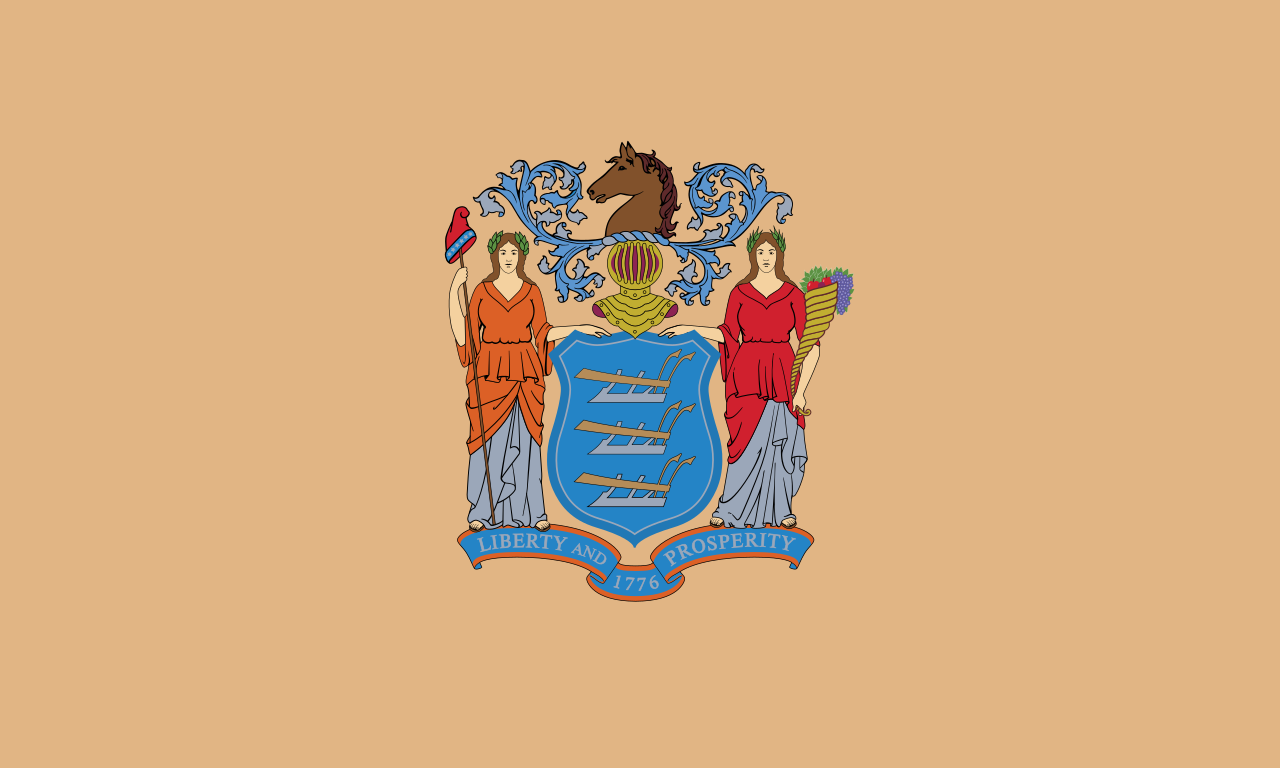
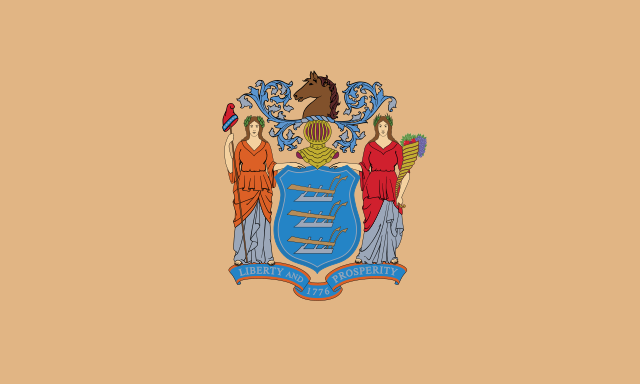
The New Jersey flag is a buff-colored field, a tan-yellow shade, carrying the state coat of arms. Liberty and Ceres stand beside a shield of three plows, over the motto Liberty and Prosperity and the date 1776.
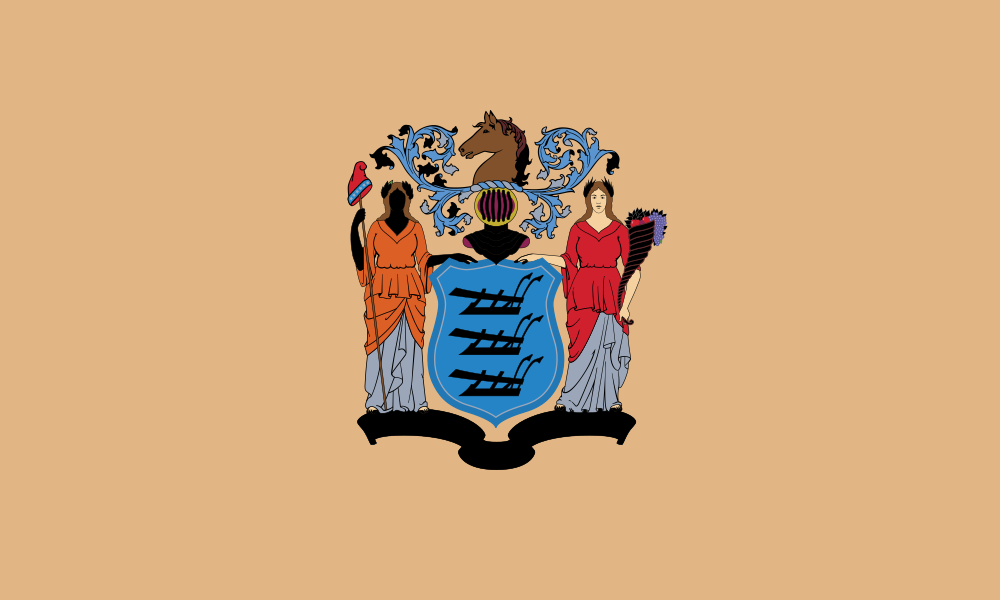
What the New Jersey state flag looks like
The state flag of New Jersey is a field of buff, a light tan-yellow color, with the state coat of arms in the center. The arms are drawn in several colors that stand out against the buff background.
The coat of arms includes:
- A shield with three plows.
- A helmet above the shield, topped by a horse's head.
- Two female figures standing on either side: Liberty on the left, holding a staff topped with a liberty cap, and Ceres, the Roman goddess of agriculture, on the right, holding a cornucopia.
- A ribbon below the shield with the motto Liberty and Prosperity and the year 1776.
New Jersey flag meaning and symbolism
The three plows on the shield stand for agriculture, which gave New Jersey its nickname, the Garden State. The horse's head crest stands for speed and strength, and the helmet for state sovereignty. Liberty stands for freedom and Ceres for abundance, which fits the motto Liberty and Prosperity. The year 1776 marks the Declaration of Independence and the year New Jersey adopted its first state constitution.
The buff color is linked to the American Revolution. In 1779 George Washington ordered that the New Jersey regiments wear dark blue coats faced with buff, and blue and buff are often called the colors of New Jersey. The yellow-tan field is therefore a historic uniform color, not gold or bright yellow.
History of the New Jersey flag
The coat of arms dates to the Revolutionary period. The state coat of arms was adopted in 1777, and the design was drawn by Pierre Eugene du Simitiere. It was modified slightly in 1928. New Jersey troops carried regimental flags bearing the arms in the Civil War.
The General Assembly formally adopted the present flag on May 11, 1896, with a buff field and the state arms. In 1965 a state law defined the exact shades of Jersey blue and buff. For comparison, see New Hampshire, or look through all U.S. state flags.
New Jersey flag colors
#E1B584RGB
225, 181, 132CMYK
0, 20, 41, 12#2484C6RGB
36, 132, 198CMYK
82, 33, 0, 22New Jersey flag facts
| Adopted | May 11, 1896 |
|---|---|
| Proportions | 3:5 |
| State capital | Trenton |
| State motto | Liberty and prosperity |
| Population | 9,288,994 |
New Jersey state flag FAQ
Why is the NJ flag yellow?
The field is buff, a tan-yellow color. It comes from the buff facings on New Jersey uniforms in the Revolutionary War, and it was chosen for the flag in 1896.
What does the New Jersey state motto mean?
Liberty and Prosperity is written on the ribbon at the bottom of the coat of arms. It pairs freedom with the abundance symbolized by farming.
What are the two women on the New Jersey flag?
Liberty holds a staff with a liberty cap. Ceres, the Roman goddess of agriculture, holds a cornucopia.
When was the New Jersey flag adopted?
The General Assembly adopted it on May 11, 1896. The coat of arms on it dates to 1777.
What does the New Jersey state flag represent?
The buff field recalls the buff facings on New Jersey Continental Army uniforms, and the coat of arms tells the state's story. Three plows stand for farming (the Garden State), the helmet for self-government, the horse's head for speed and strength, and Liberty and Ceres for the motto Liberty and Prosperity. The General Assembly adopted the flag on May 11, 1896.
What does the New Jersey flag look like?
It is a buff-colored field with the full-color state coat of arms in the center: a shield of three plows, a helmet and horse's head above, Liberty and Ceres on either side and a ribbon reading Liberty and Prosperity 1776. New Jersey's Secretary of State gives the buff as #E1B584 and Jersey blue as #2484C6, shades set by a 1965 law.